

 Share your story and shine at JK Monitor!🌟 Welcome to JK Monitor, where every story matters and every achievement is celebrated! We invite you to share the remarkable journey of your life and showcase your accomplishments to the world. Join our exclusive interviews that honor exceptional individuals just like you.
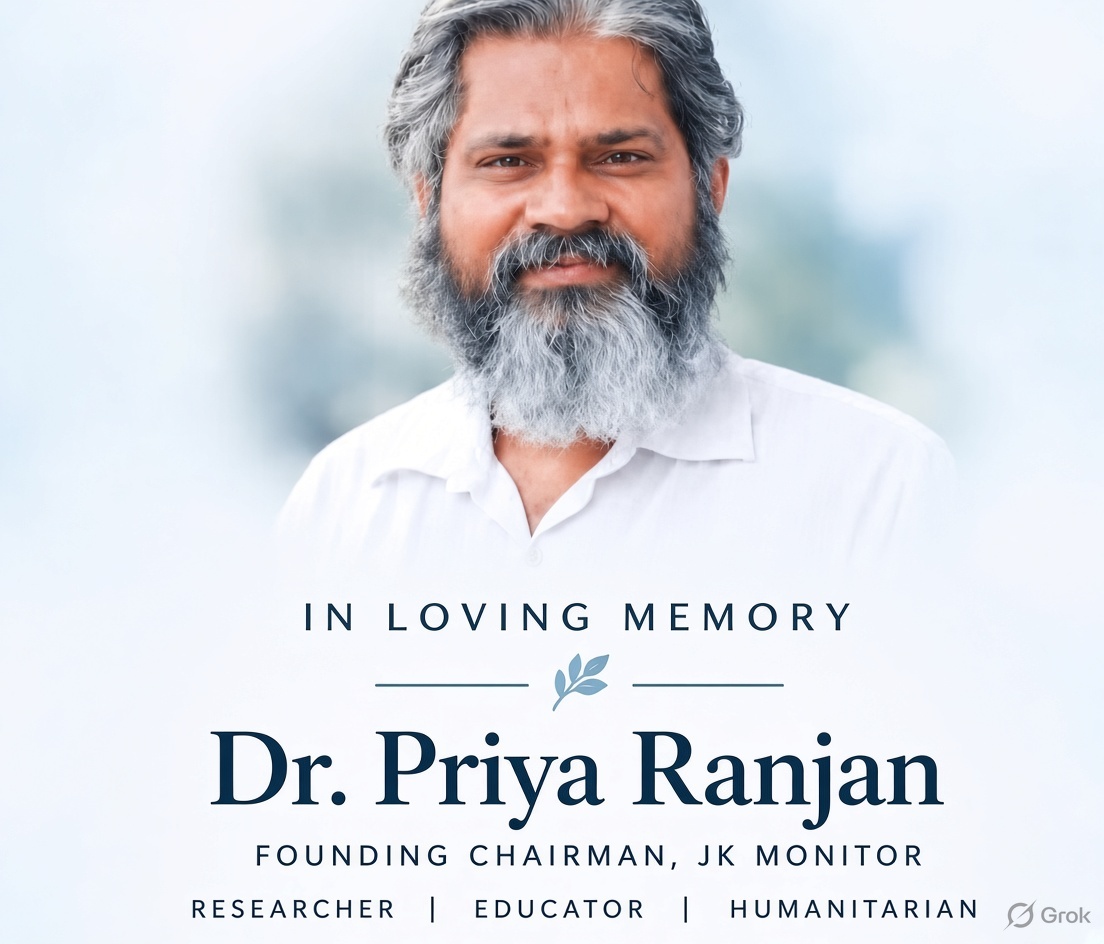 I will always remember Dr. Priya Ranjan not only as the Chairman of JK Monitor, but as a mentor, guide and elder brother whose kindness shaped my life and work. Write a tribute at
JAMMU: Chief Secretary, Atal Dulloo today chaired a comprehensive review meeting of the Higher Education Department (HED) to strategise a forward-looking roadmap for advancing higher education and steering Higher Educational Institutions (HEIs) in Jammu and Kashmir towards excellence.
The meeting was attended by the Vice-Chancellors of various Universities; Commissioner Secretary, HED; Registrars of the Universities; Director Colleges; and other senior officers of the department.
Emphasising the need for institutional accountability and time-bound reforms, the Chief Secretary directed all HEIs to formulate their own actionable plans for implementation of reform measures recommended during the 5th Chief Secretaries’ Conference chaired by the Prime Ministerhimself. He stressed strict adherence to timelines and called for a results-oriented approach without any laxity.
He observed that these reform measures are closely aligned with the National Education Policy (NEP) 2020 and form a strong foundation for achieving the objectives envisioned for higher education institutions in the Union Territory.
Taking a detailed review of faculty positions and student enrollment across universities and colleges, the Chief Secretary directed that faculty vacancies be filled up to at least 90 percent by August this year, underscoring that quality education hinges on adequate and competent teaching staff.
Highlighting the need for academic relevance, he called for a comprehensive audit of all courses offered by universities and affiliated colleges. He stressed that courses with low demand or outdated content should be phased out and replaced with emerging, technology-driven programmes that align with market needs and student aspirations.
The Chief Secretary also emphasised regular updation of curricula to reflect latest developments and research in respective fields. He instructed institutions to integrate skill-based courses with conventional academic programmes to enhance employability and industry readiness of graduates.
Focusing on professional education, he directed the Vice-Chancellors of IUST and SMVDU to undertake a detailed study of engineering colleges and schools of architecture in the UT and recommend measures to improve enrolment. He noted that these institutions possess robust infrastructure and faculty, which must be optimally utilised.
Similarly, the Vice-Chancellors of the University of Kashmir and University of Jammu were asked to assess enrolment trends in their affiliated colleges and suggest corrective measures, particularly in institutions witnessing low student intake. The Chief Secretary also reviewed the status of infrastructure development in newly established colleges and stressed expeditious completion of ongoing construction works.
During the meeting, the Vice-Chancellors presented updates on implementation of the 21 reform points identified in the Chief Secretaries’ Conference. They also outlined their respective roadmaps and assured timely and effective execution of these reforms.
Earlier, Commissioner Secretary, HED, Ram Niwas Sharma presented a detailed overview of the higher education landscape in Jammu and Kashmir. He apprised the meeting of the existing faculty strength, vacancies, course offerings, seat matrix and enrolment trends across institutions.
It was informed that the Union Territory has 09 Universities and 152 Colleges, including 144 Government Degree Colleges, 03 Autonomous Colleges, 02 Engineering Colleges and 03 Private Grant-in-Aid Colleges. Additionally, there are 208 private colleges offering B.Ed, engineering, law and other programmes. It was informed that the total student enrolment across these institutions currently exceeds three lakh.
Regarding staffing, it was informed that out of 3,635 sanctioned teaching and 2,955 non-teaching posts, 3,425 teaching and 2,413 non-teaching positions are filled, with efforts underway to fill the remaining vacancies.
The meeting also held an in-depth university-wise review of key reform initiatives, including the launch of a Global Talent Return Scheme, engagement of Professors of Practice, mission mode faculty recruitment in institutions with over 30 percent vacancies, development of delivery partnership agreements, curriculum reforms integrating emerging areas, adoption of unified digital platforms, apprenticeship-embedded degree programmes and cross-disciplinary frameworks.
Other major reform areas discussed included integration of skill courses as per UGC guidelines, implementation of vacancy-linked grants, promotion of foreign collaborations and campuses, training of at least 25 percent faculty in emerging technologies, regulatory streamlining, strengthening of quality and autonomy in colleges, development of innovation ecosystems through incubation centres, and increasing international student enrolment by 20 percent.
The reform agenda further envisages conversion of select HEIs into model finishing schools, enhancement of Gross Enrolment Ratio (GER), expansion of skill-based education, establishment of a multiversity, development of mega educational hubs and clusters, and setting up of research parks in both Jammu and Kashmir divisions.
The Chief Secretary reiterated the commitment of transforming the higher education ecosystem into a dynamic, inclusive and globally competitive sector, capable of producing skilled, innovative and employable youth by the institutions established across the districts of J&K.
