

 Share your story and shine at JK Monitor!🌟 Welcome to JK Monitor, where every story matters and every achievement is celebrated! We invite you to share the remarkable journey of your life and showcase your accomplishments to the world. Join our exclusive interviews that honor exceptional individuals just like you.
 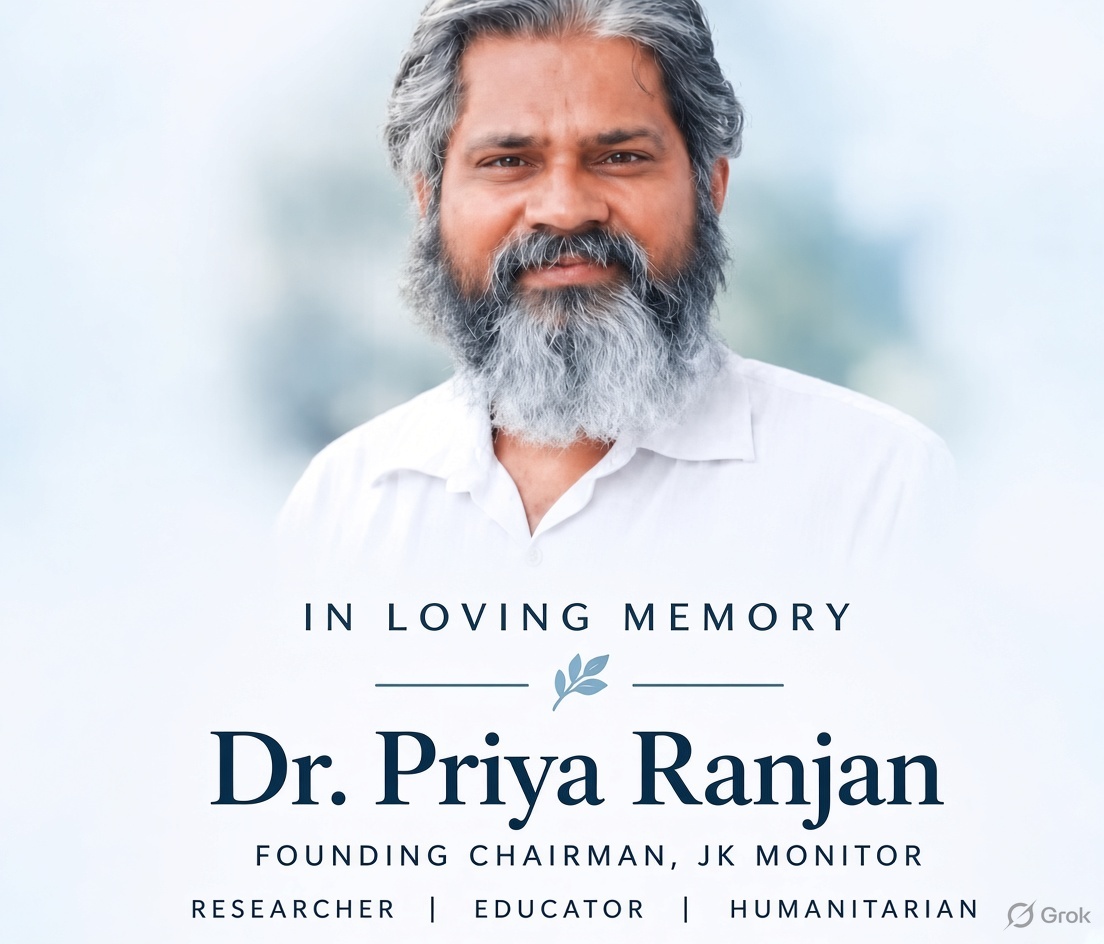 I will always remember Dr. Priya Ranjan not only as the Chairman of JK Monitor, but as a mentor, guide and elder brother whose kindness shaped my life and work. Write a tribute at
 JAMMU: The two-day program, titled "POCSO Act and POSH Act with Special Reference to SAMVAD’s Training Manual and Combating Gender Stereotypes," today concluded at the J&K Police Auditorium in Gulshan Ground, Jammu.
The first session of the second day was conducted by U.K. Jalali, Sr. Advocate, High Court of J&K and Ladakh and Member GSICC and also former Advocate General, who discussed that relying on predetermined stereotypes in judicial decision-making contravenes the duty of judges to decide each case on its merits, independently and impartially. In particular, reliance on stereotypes about women is liable to distort the law’s application to women in many harmful ways.
The resource person explained that even when the use of stereotypes does not alter the outcome of a case, stereotypical language may reinforce ideas contrary to our constitutional ethos. Language is critical to the life of the law. He said that the language a judge uses reflects not only their interpretation of the law, but their perception of society as well.
He said that the Handbook on Combating Gender Stereotypes contains a glossary of gender-unjust terms and suggests alternative words or phrases which may be used while drafting pleadings as well as orders and judgments. However, challenging and overcoming stereotypes is essential to ensuring an equal, inclusive, and compassionate society.
He also explained the Interplay of POCSO Act and Juvenile Justice (Care and Protection of Children) Act, 2015. The second session was conducted by Sonia Gupta, PDJ Reasi who gave a detailed overview on rehabilitation and compensation for Child Victims of Sexual Offences.
The resource person reiterated that POCSO Act and related frameworks underscores the importance of addressing both the legal and emotional needs of the child. She also underlined that by focusing on the parameters for determining compensation, balancing justice with child welfare, providing legal and medical aid, and ensuring access to counselling services, the legal system aims to create an environment where child victims can heal, regain their sense of self-esteem, and pursue their dreams. She also added that effective implementation of these provisions requires ongoing collaboration between legal, medical, and psychological professionals, along with a strong commitment to upholding the rights and dignity of child survivors.
Justice Sanjeev Kumar, Chairman, Governing Committee for J&K Judicial Academy, while delivering the concluding remarks, emphasized that many new legislations are enacted to address the nuances of crime but this doesn’t cure the ill. The need of special legislation like POCSO Act was there to address the exponential rise in the number of cases of sexual abuse of children.
He observed that the Act directs the use of more humane methods of dealing with victims and prohibits judicial victimization of children. Justice Shukla addressed that around 28% of children experience some form of sexual abuse or sexual harassment one way or the other. He underlined that reporting, investigation, prosecution and adjudication of cases under POCSO Act and also the rehabilitational requirements of the of the victim must be done expeditiously, precisely and effectively by the concerned stakeholders for safeguarding the interest and well-being of the child at every stage of the Judicial process.
All the sessions remained very interactive during which all the participants actively participated and shared their own experiences, and also discussed various aspects of the subject topics. They also raised a number of queries which were answered effectively by the eminent resource persons. The programme was concluded with the concluding remarks by Yash Paul Bourney, Director, J&K Judicial Academy.
