

 Share your story and shine at JK Monitor!🌟 Welcome to JK Monitor, where every story matters and every achievement is celebrated! We invite you to share the remarkable journey of your life and showcase your accomplishments to the world. Join our exclusive interviews that honor exceptional individuals just like you.
 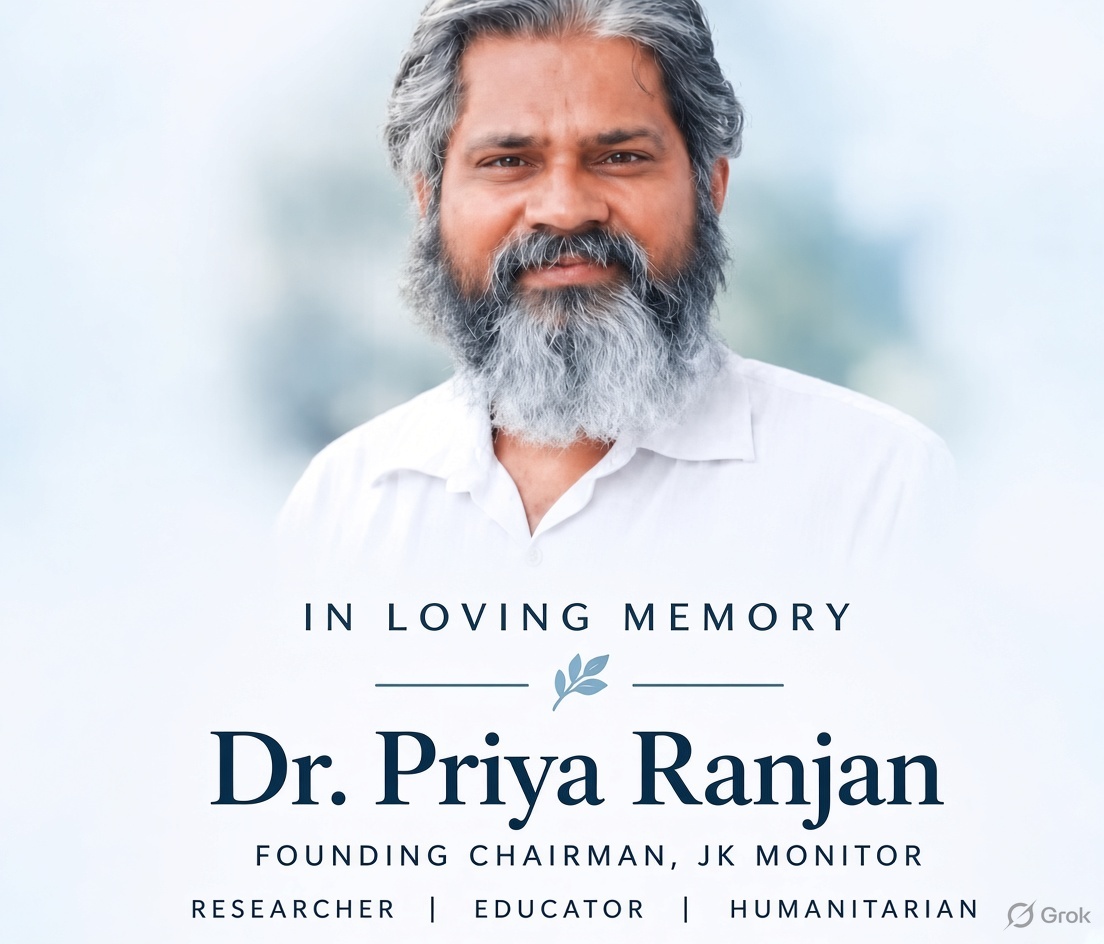 I will always remember Dr. Priya Ranjan not only as the Chairman of JK Monitor, but as a mentor, guide and elder brother whose kindness shaped my life and work. Write a tribute at
 SAMBA: Amb. (Retd.) G. Parthasarathy, Honorable Chancellor, Central University of Jammu, visited for the 9thmeeting of the Court in the CU Jammu Campus. He was warmly received by the Honorable Vice-Chancellor, Prof. Sanjeev Jain, and The Registrar, Prof. Yashwant Singh.
As part of the visit, the Chancellor delivered a special lecture titled “Development and Changes in Foreign and Security Policies in India” focused on assessing the dynamic transformations occurring in India’s external environment. In a welcome address at the beginning of the special lecture, Prof. Yashwant Singh, Registrar, CU Jammu highlighted the Chancellor’s achievements as a seasoned diplomat and renowned scholar.
He also highlighted the importance of the special lecture and foreign policy in the ever-evolving geopolitical landscape. The Registrar conveyed sincere appreciation to Prof. Sanjeev Jain, Honorable Vice Chancellor, CU Jammu for his unwavering support and visionary guidance for the event. Further, the Registrar also acknowledged the role of the Department of National Security Studies in organising this lecture and expressed gratitude to Dr. R. Sudhakar, Associate Professor of the department for his contributions as a coordinator of the event.
Amb. (Retd.) G. Parthasarathy, Honorable Chancellor during the lecture recalling his ambassadorial tenure in the USSR, the Chancellor divulged how the Pakistan-China alliance had evolved during the 1971 Bangladesh Liberation War, posing a threat to India’s foreign and security policy in the subsequent period. He also mentioned how India successfully countered this two-front challenge. He emphasized that Pakistan is less relevant in India’s security calculations in the contemporary period. However, with China’s help, especially in the nuclear domain, Pakistan poses a tangible level of threat to India.
The Chancellor also delved into the changing dynamics at the global level and the challenges and opportunities they pose to India. He assessed India’s neighborhood with respect to Bangladesh, Nepal and Pakistan. The instability in Pakistan has resulted from its long-term policies, and this instability, he stressed, has been generating scepticism in China as well. China’s long-term policy against India is marked by unsuccessful attempts for low-cost pressure to diminish India’s economy.
With Donald Trump’s recent victory, India is projected to have a good relationship with the US compared to the outgoing Democrat President. Further he mentioned that establishing robust ties with the Gulf countries has been another achievement of India’s diplomacy over the years and India has leveraged its maritime ties in forging strong ties in the energy and economic sector in this region.
The millions of India’s expatriate population in the Gulf region is another asset to India’s economy and diplomacy. The Chancellor also held that India’s performance in the international system is based on its impressive economic growth in the post-liberalization period. The international institutions have been projecting the brighter prospects for this growth. This becomes important as strong foreign policy and bold negotiations of a nation are dependent on its economic power.
Concluding the lecture, Amb. (Retd.) G. Parthasarathy emphasized that any country's dynamic foreign policy should rely on its national interest, which is based on its national consensus. India has been successful in forging a consensus over national interest and balancing its economic resilience and defence preparedness.
The lecture was followed by interesting questions from the audience about India’s contemporary issues with Pakistan and China. Prof. Ritu Bakshi, Dean of Students’ Welfare, CU Jammu, delivered a formal vote of thanks. She extended her gratitude to the Honorable Chancellor for the engaging and profoundly insightful lecture. She also expressed her gratitude for the Honorable Vice Chancellor, Prof. Sanjeev Jain, acknowledging his significant contributions to the development of the Central University of Jammu.. The event was anchored by Ms. Abhigya Langeh, research scholar at the Department of National Security Studies, CUJ.
