
 Share your story and shine at JK Monitor!🌟 Welcome to JK Monitor, where every story matters and every achievement is celebrated! We invite you to share the remarkable journey of your life and showcase your accomplishments to the world. Join our exclusive interviews that honor exceptional individuals just like you.
  Very disturbing news is coming from Nepal regarding flash floods triggered by melting glaciers, with a huge loss of precious human lives and properties. Let us pray for the safety of the people of Nepal. But this tragedy must also serve as a wake-up call the J&K Government. Are we truly prepared for such disasters, even after witnessing extreme weather events across the UT in 2025 and 2026? We have already seen rivers turn into executioners, claiming lives, washing away livestock and destroying homes in multiple districts. Yet, we seem to awaken only after disaster strikes.
The pattern is painfully similar. Authorities express customary grief, announce compensation and launch rescue operations, but rarely invest in prevention. There is no serious effort to slow down or mitigate these disasters. The truth is that these are increasingly man-made disasters, born of unsustainable development, deforestation and ecological plunder.
Mountains are blasted to lay concrete bitumen roads in fragile zones, forests are encroached upon for palatial houses, and riverbanks & riverbeds are occupied by illegal constructions. Wetlands are shrinking, illegal mining continues with little interruption, and plastic waste chokes our towns and cities, emitting greenhouse gases that worsens global warming.
At the heart of this crisis lies the mass felling of trees, an act of ecological self-harm that we have normalised as "development". Lakhs of indigenous, old tall trees have been cut down in the last five years alone for major road projects, stripping our catchments of their natural stability. Trees are not mere decoration; they are the Himalayas' lungs and lifelines. Their canopies intercept rainfall, their roots bind soil and rock, and their transpiration cools the air and regulates local precipitation. When forests disappear, temperatures rise sharply, moisture retention falls, and the atmosphere becomes more prone to sudden, intense convection that manifests as cloudbursts. Without tree cover, glaciers are exposed to higher ambient temperatures and accelerated melting, while rainwater, instead of being absorbed and released slowly, rushes downhill as destructive runoff, triggering flash floods and landslides.
Rising temperatures in the Kashmir valley and hilly areas are no longer debatable; they are a lived reality. Districts like Ladakh, Ganderbal, Poonch and Kishtwar now face heightened threats from overstressed glacial lakes. In this context, there is an urgent need to set up a robust satellite-based monitoring system for these overstressed glacial lakes and rapidly melting glaciers. Such a system must be coupled with an end-to-end early warning mechanism for people living in downstream areas, supplemented by regular mock drills and the declaration of all flood-prone corridors as no-habitation zones. Every encroachment on forest lands, river shores and riverbeds must be removed with strong political will, free from self-interest or biased approach.
Equally required is the creation of a dedicated ministry for Climate Change and Global Warming at both the Union and UT levels. Climate change is not a peripheral issue that can be managed through occasional statements or fragmented projects; it is an existential threat that demands coordinated, cross-sectoral action. A separate ministry would bring climate mitigation and adaptation to the centre of governance, linking land-use planning, forest conservation, water management, energy policy, waste management and urban development into a coherent strategy for survival. It would ensure that decisions on roads, resorts, mining and plastics are evaluated through a climate-risk lens, rather than being driven by short-term expediency. Without such institutional focus, climate action will remain reactive, disjointed and inadequate.
The tragedy unfolding in Nepal is not a distant headline — it is a terrifying preview of Jammu and Kashmir's own tomorrow, unless we choose, urgently and decisively, to act today. The same glacial forces that have turned Nepal's rivers into instruments of death are silently building pressure across the peaks of Kishtwar, the valleys of Poonch and the frozen lakes of Ladakh. Every delayed decision, every encroachment ignored, every forest felled in the name of progress is a debt we are accumulating against nature — and nature, unlike banks, charges no interest but demands full and sudden repayment, always in terms of human lives. The people of Nepal are counting their dead. If we persist in our complacency, Jammu and Kashmir will be counting its own. The Himalayas do not forgive arrogance. They do not bargain with greed. They do not wait for policy meetings, budget approvals or election cycles. They have already issued their verdict — in floodwaters, in landslides, in the slow and irreversible retreat of glaciers that have stood for millennia. The rivers have spoken. The mountains are trembling. The question is no longer whether disaster will come — the question is whether we will have the courage, the conscience and the political will to stand between our people and catastrophe. That answer cannot wait. It must be given now, in action, not in words.
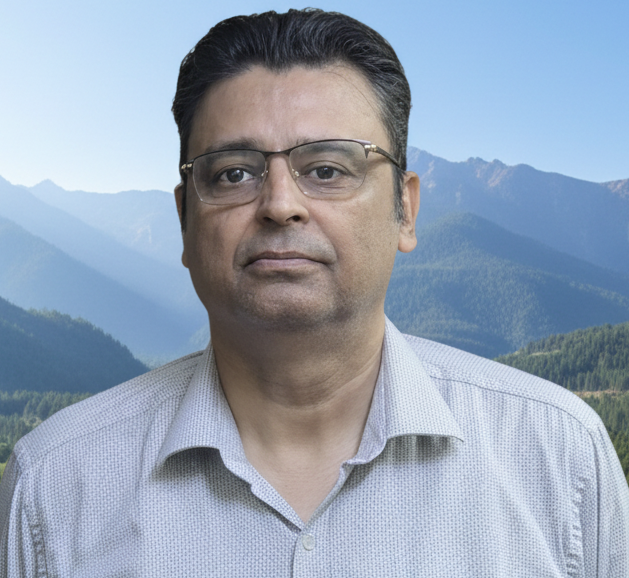
The author is an Environmental Advocate and Policy Writer. Presently, he is the convenor of We The Humans Forum for Nature and Mankind, a public charitable trust. He served in the Department of Horticulture and retired as a District Officer.