

 Share your story and shine at JK Monitor!🌟 Welcome to JK Monitor, where every story matters and every achievement is celebrated! We invite you to share the remarkable journey of your life and showcase your accomplishments to the world. Join our exclusive interviews that honor exceptional individuals just like you.
 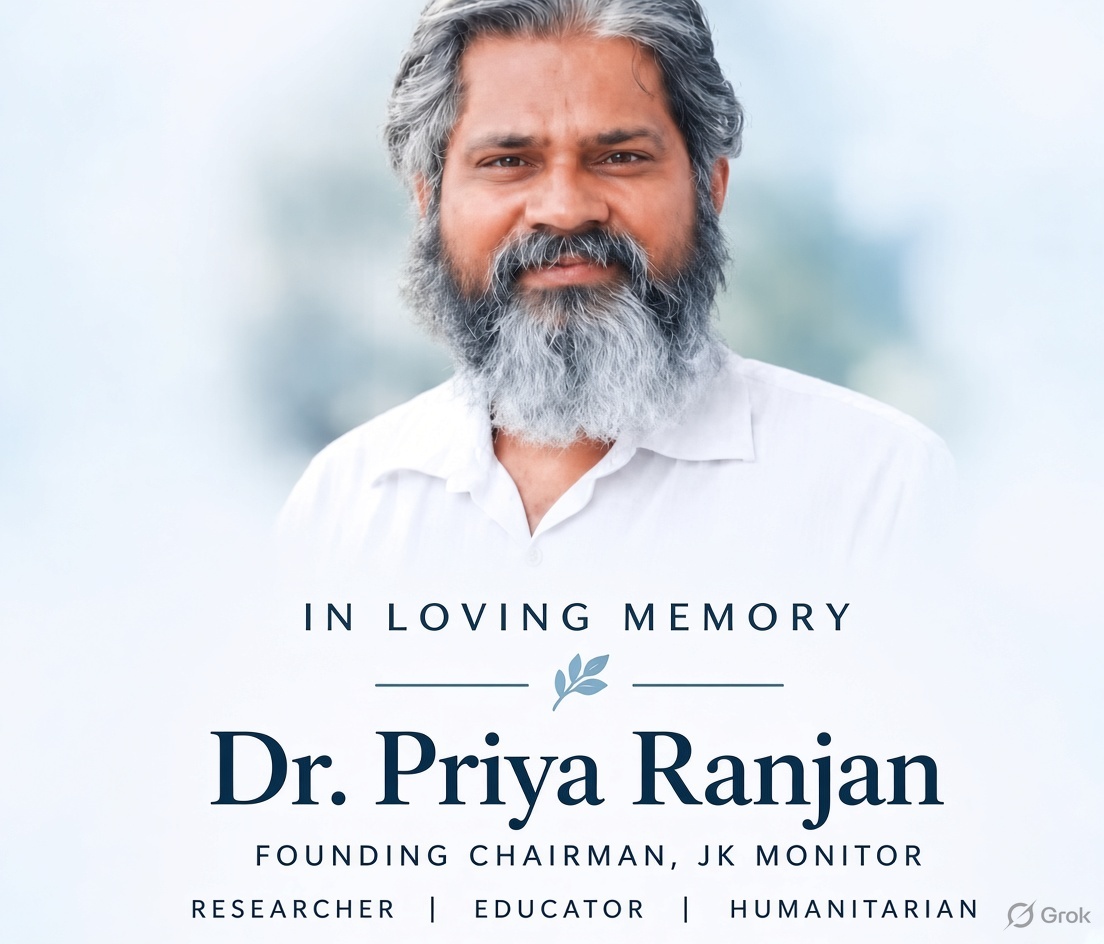 I will always remember Dr. Priya Ranjan not only as the Chairman of JK Monitor, but as a mentor, guide and elder brother whose kindness shaped my life and work. Write a tribute at
 - Policy envisages three-tier waste management framework, regional resource recovery clusters, ₹3,548.7 crore 10-year planning envelope
SRINAGAR: Chief Minister Omar Abdullah has described the newly notified Jammu & Kashmir Circular Economy Policy, 2026, as “a decisive step towards resource recovery, green growth and ecological sustainability,” marking a shift towards a low-waste, resource-efficient development model tailored toJammu and Kashmir’s diverse geographical and settlement patterns.
The policy envisages a differentiated three-tier governance framework: Circular, Circular+ and Circular++ to align waste management, recycling, resource recovery and wastewater reuse systems with the capacities and requirements of local bodies. It provides for decentralised processing in small and remote areas, hub-and-spoke logistics across intermediate corridors, and advanced circular economy systems in major urban centres, including Jammu and Srinagar.
Recognising the diversity of waste streams across Jammu and Kashmir, the policy covers municipal solid waste, food and wet waste, tourism-related waste, horticulture and agricultural biomass, packaging waste, construction and demolition debris, e-waste and wastewater. It also seeks to promote material recovery through repair, refurbishment and reuse, including resource loops linked to wool and handicrafts.
To address terrain-related and logistical constraints, the roadmap provides for targeted regional value-chain clusters to facilitate the aggregation, transportation, recovery and productive utilisation of materials. These clusters are envisaged around urban material recovery, apple and horticulture biomass, tourism circuits and artisan material loops, linking waste management with local economic activity and livelihood generation.
The policy outlines an indicative 10-year planning envelope of ₹3,548.7 crore, with financing envisaged through convergence with Central schemes, Extended Producer Responsibility (EPR) mechanisms and user charges, alongside opportunities for Public-Private Partnerships. The framework seeks to support long-term infrastructure development while reducing dependence on recurring government subsidies.
A key objective of the policy is to achieve over 90 per cent urban material recovery through improved source segregation, greater diversion of waste from landfills and the development of sustainable green livelihoods. It also seeks to create opportunities for self-help groups, youth and waste workers by integrating resource recovery into local economic activity.
With its focus on decentralised solutions, regional specialisation and resource efficiency, the Jammu & Kashmir Circular Economy Policy, 2026, provides a long-term framework for strengthening environmental sustainability while supporting more resilient urban and rural development across J&K.
