

 Share your story and shine at JK Monitor!🌟 Welcome to JK Monitor, where every story matters and every achievement is celebrated! We invite you to share the remarkable journey of your life and showcase your accomplishments to the world. Join our exclusive interviews that honor exceptional individuals just like you.
JAMMU: Minister for Tribal Affairs, Food, Civil Supplies & Consumer Affairs and Transport, Javed Ahmed Rana, today called for identifying and honouring the men and women who have shaped Jammu and Kashmir’s tribal history, saying their contributions deserve to be remembered with the same pride with which the nation honours Birsa Munda.
Rana was speaking as chief guest at the Janjatiya Gaurav Diwas function organised by the Tribal Affairs Department under the aegis of Tribal Research Institute at Kala Kendra here to mark the 151st birth anniversary of Birsa Munda. The function also marked the culmination of Janjatiya Gaurav Pakhwada, observed across the country from November 1 to 15.
The J&K Tribal Affairs Department said the Union Territory ranked first among States and Union Territories in the number of Pakhwada events uploaded to the Adi Prasaran portal. The Union Ministry of Tribal Affairs had appreciated the department and its district teams for their work during the fortnight, it said.
Observed on November 15 since 2021, Janjatiya Gaurav Diwas honours the contribution of tribal communities to India’s freedom struggle and celebrates their cultural heritage. The date commemorates the birth of Birsa Munda, who was born in 1875 at Ulihatu in present-day Jharkhand. He led the Ulgulan, an uprising against British rule to defend his people’s rights over their land.
Rana opened the programme by inaugurating the department’s photo exhibition. He went around the gallery and viewed the photographs, paintings, traditional jewellery, handicrafts and other artefacts depicting the lives of J&K’s tribal communities.
Addressing the gathering, the Minister said each tribal community had contributed to the history of Jammu and Kashmir. He stressed the need to preserve the languages, songs and crafts handed down within families so that younger generations could learn these traditions and know the people who kept them alive.
Rana lauded the Tribal Research Institute, J&K, saying it had done substantial work to document the region’s tribal heritage. The Institute has worked with IIT Jammu to record Gojri folklore in the Pir Panjal region. During 2026-27, the department sanctioned a project in favour of IIT Jammu to develop a digital repository of tribal knowledge, including oral histories, folk music and traditional crafts.
The Minister felicitated meritorious tribal students for their academic achievements and handed over housing sanction letters to beneficiaries under the Pradhan Mantri Awaas Yojana-Gramin (PMAY-G). He also distributed tents, portable water tanks for storing drinking water, and solar lights to eligible families identified by the department.
Artistes from the Gujjar, Bakarwal, Pahari, Gaddi, Sippi and other tribal communities presented a colourful programme of folk music and dance. Gojri and Pahari folk songs featured in the performances, with artistes taking the stage in the traditional attire of their communities.
Commissioner Secretary, Tribal Affairs Department, Sheetal Nanda, commended the department for bringing the communities together. She said the diversity of J&K’s tribes could be seen in details as familiar as the way a garment was worn or a piece of jewellery was fashioned. Each community had customs and a history of its own, she said, and the exhibition and performances gave the audience an opportunity to appreciate those differences.
Dr Javaid Rahi, Secretary, Kala Kendra Society, Jammu, delivered the keynote address. A scholar of Gojri language and folklore, Dr Rahi has documented folk songs and stories of the Gujjar and Bakarwal communities.
During the Pakhwada, districts combined cultural programmes with welfare outreach. In Samba, Rana announced a girls’ hostel at an estimated cost of Rs 7 crore. A Gram Sabha in Shopian’s Kanjiullar block took up forest rights claims from tribal residents, while health workers held a screening camp at the Anganwadi centre in Kanzalwan, Bandipora.
Director, Tribal Affairs, J&K, Mohammad Mumtaz Ali, and other officers of the department attended the function. Dr Abdul Khabir, Deputy Director, Tribal Affairs, Jammu, and Nodal Officer, Tribal Research Institute, J&K, conducted the proceedings.
In loving memory of Dr. Priya Ranjan: A mentor who treated me like family
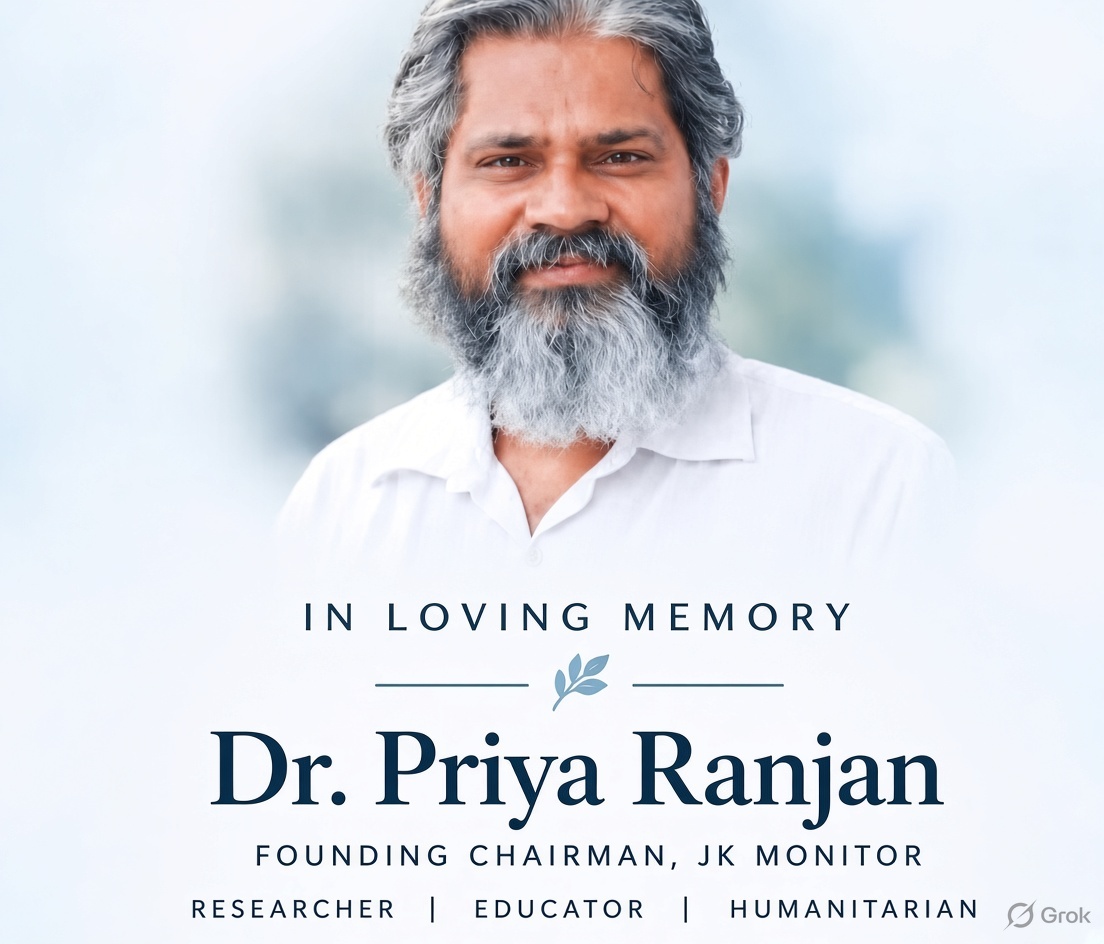
I will always remember Dr. Priya Ranjan not only as the Chairman of JK Monitor, but as a mentor, guide and elder brother whose kindness profoundly shaped my life and work. Write a tribute at In Loving Memory · Dr. Priya Ranjan
When he appointed me Editor-in-Chief of JK Monitor, he never treated me as an employee, but as a younger brother, offering warmth, trust, respect and invaluable guidance. I will always be grateful for his faith in me, his encouragement and the lessons he shared.
Dr. Ranjan was a rare and noble soul—humble, compassionate, intellectually brilliant and always willing to help others. A visionary thinker, he believed in using knowledge and abilities to make a meaningful difference. His influence lives on through the people he guided, the work he inspired and the countless lives he touched.
For me, he will always be the elder brother who believed in me and guided me with affection. I will cherish his kindness and lessons forever. May his soul rest in eternal peace. He will be deeply missed and never forgotten.
(Ajmer Alam Wani)
