

 Share your story and shine at JK Monitor!🌟 Welcome to JK Monitor, where every story matters and every achievement is celebrated! We invite you to share the remarkable journey of your life and showcase your accomplishments to the world. Join our exclusive interviews that honor exceptional individuals just like you.
 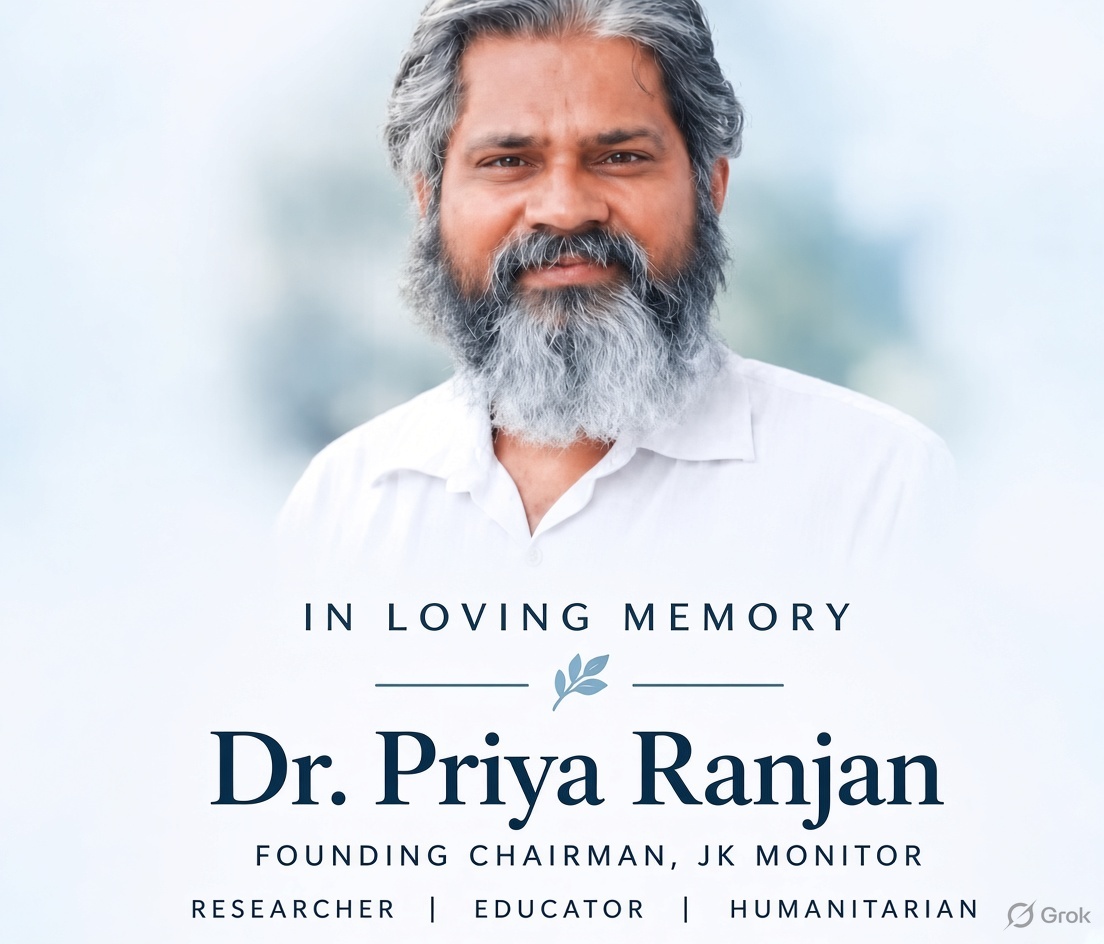 I will always remember Dr. Priya Ranjan not only as the Chairman of JK Monitor, but as a mentor, guide and elder brother whose kindness shaped my life and work. Write a tribute at
 NEW DELHI: Young researchers and interns of the Centre for NaMo Studies (CNMS) brought Gen Z perspectives to the forefront of the national discourse on education reform by presenting papers on various dimensions of the National Education Policy (NEP) 2020 at a national seminar organised by CNMS in collaboration with the Dr. Ambedkar International Centre New Delhi.
This particular session for CNMS interns, chaired by Prof Raman Chadha, featured young researchers who presented their perspectives on various dimensions of NEP 2020. Vanshika Pandey of Gargi College, University of Delhi presented her views on “Gender Equity in Higher Education under NEP 2020.”Shreya Vij of the DU addressed “Beyond Rote: Assessment Reforms Under NEP 2020,” while Akshita Paul of the University of Delhi spoke on “NEP 2020, From Policy to Possibility: Bridging the Access Gap for an Equitable, Agency-Driven Education. ”Navita Patel of Gargi College, University of Delhi presented “The Student NEP Never Met: Promise, Possibility and the Reality of NEP 2020.”
Col Akash Patil Director of the Dr. Ambedkar International Centre (DAIC) said that the Centre for NaMo Studies is doing meaningful research work for Viksit Bharat and Rashtra Nirman by connecting Gen Z with issues of national importance. He said that engaging the younger generation in discussions on education, public policy and national development is essential for creating an aware, responsible and future-ready generation. Appreciating the efforts of CNMS, he said that providing young people with platforms to deliberate on important national issues would help them become active stakeholders in the journey towards Viksit Bharat.
Prof. Jasim Mohammad, Managing Trustee, Centre for NaMo Studies (CNMS) said that, PM Shri Narendra Modi has brought about a transformative reform in India’s education system through the National Education Policy (NEP) 2020, laying the foundation for a more inclusive, innovative, skill-oriented and future-ready education system.
The CNMS interns actively participated as representatives of Gen Z in the discourse on educational transformation and Rashtrinirman, reinforcing the importance of providing young Indians with meaningful opportunities to engage with national policies and contribute their ideas to the vision of Viksit Bharat 2047.
