

 Share your story and shine at JK Monitor!🌟 Welcome to JK Monitor, where every story matters and every achievement is celebrated! We invite you to share the remarkable journey of your life and showcase your accomplishments to the world. Join our exclusive interviews that honor exceptional individuals just like you.
 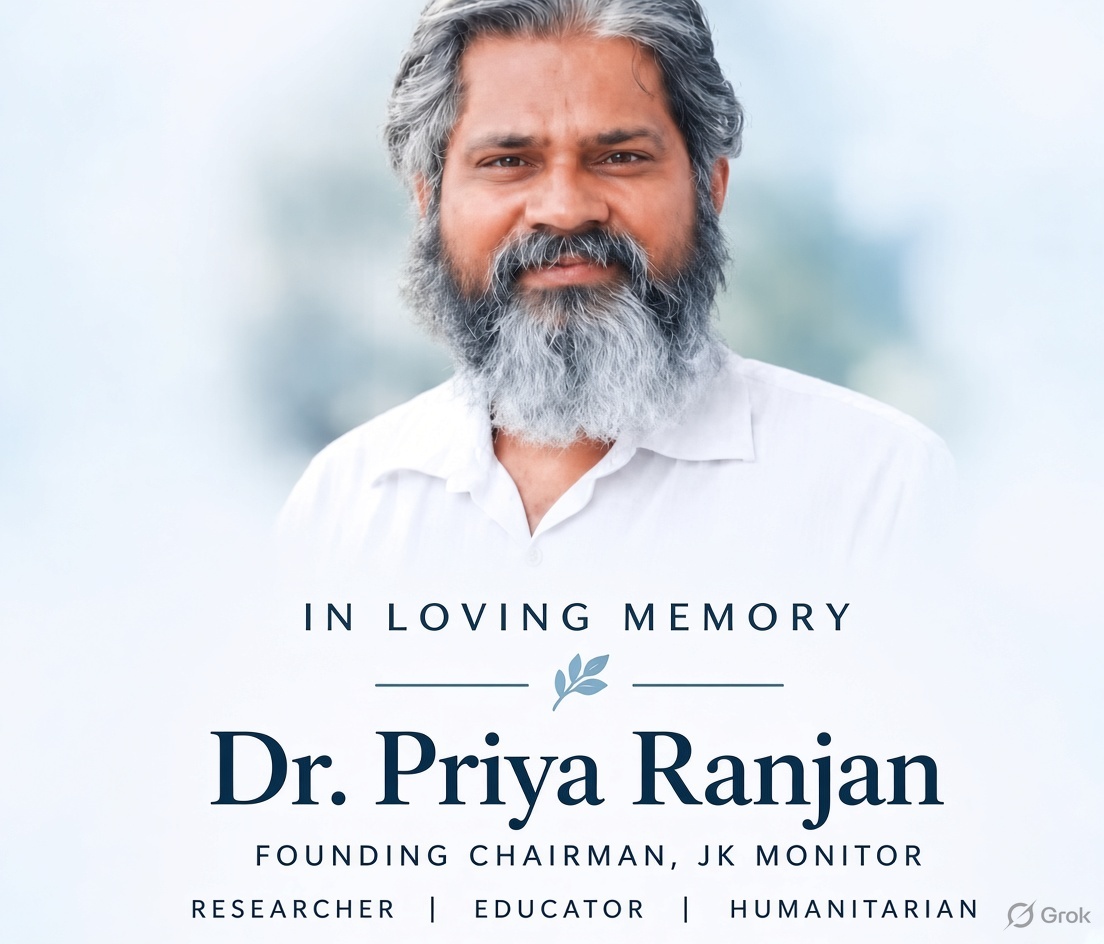 I will always remember Dr. Priya Ranjan not only as the Chairman of JK Monitor, but as a mentor, guide and elder brother whose kindness shaped my life and work. Write a tribute at
 CHANDIGARH: The Federation of Self Financing Technical Institutions (FSFTI), All India, has formally urged the Ministry of Health & Family Welfare and the National Commission for Allied & Healthcare Professions to reconsider the decision making the National Eligibility Entrance Test (NEET) mandatory for admission to Paramedical (Allied & Healthcare) courses nationwide. As per Letter No. F. No. 220025/9/2020-NCAHP, NEET has been prescribed as a compulsory eligibility requirement—an approach FSFTI believes could adversely affect access to paramedical education, especially for students from rural, semi-urban, and economically weaker sections.
National Healthcare Workforce Shortage
Dr. Anshu Kataria, President, Federation of Self Financing Technical Institutions and Chairman, Aryans Group of Colleges, Rajpura (near Chandigarh) mentioned that despite having over 7,000–8,000 paramedical and allied health institutions across government and private sectors, India faces a severe shortage of trained healthcare support staff. Based on national workforce assessments and WHO-aligned projections, the country is short of 6–7 million allied and healthcare professionals—impacting hospital efficiency, diagnostic capacity, and patient outcomes.
Role of Paramedical Education
Dr. Anshu Kataria emphasized that paramedical programmes are skill-oriented and employment-focused, forming the backbone of India’s healthcare delivery system. These courses are designed to produce trained healthcare support professionals who directly contribute to patient care, diagnostics, and emergency services.
Future Demand vs. Restrictive Admissions
Dr KVK Rao, General Secretary, FSFTI With the rapid expansion of government medical colleges, Ayushman Bharat hospitals, private healthcare facilities, diagnostic centres, and emergency services, India is projected to need an additional 8–10 million paramedical and allied healthcare professionals over the next 10–15 years. Dr Rao questioned the rationale of tightening admission norms amid acute manpower shortages, warning that restrictive policies could reduce enrolments, increase dropouts, and further strain healthcare institutions.
Impact on Students from Weaker Sections
RS Munirathanam, Chief Patron, FSFTI mentioned that most Allied Health students typically score 50–65% and come from lower-middle or economically weaker backgrounds. They choose these affordable, skill-based programmes as practical alternatives to costly competitive exams. In contrast, NEET aspirants largely belong to more affluent sections aiming to become doctors. Making NEET mandatory—even when eligibility only requires “appeared in NEET”—adds unnecessary financial burden and mental stress, offers no merit value, and disproportionately benefits the coaching industry and the NTA, undermining the inclusive objective of Allied Health education.
Appeal for Inclusive Policy
FSFTI has therefore appealed to the Government and NCAHP to reconsider NEET as a mandatory criterion for paramedical courses and to adopt more inclusive, merit-based, and skill-oriented admission mechanisms. “At a time of massive workforce shortages, policies should encourage participation, not restrict it. India urgently needs more trained healthcare hands on the ground to meet present and future challenges,” Dr. Kataria concluded.
