

 Share your story and shine at JK Monitor!🌟 Welcome to JK Monitor, where every story matters and every achievement is celebrated! We invite you to share the remarkable journey of your life and showcase your accomplishments to the world. Join our exclusive interviews that honor exceptional individuals just like you.
 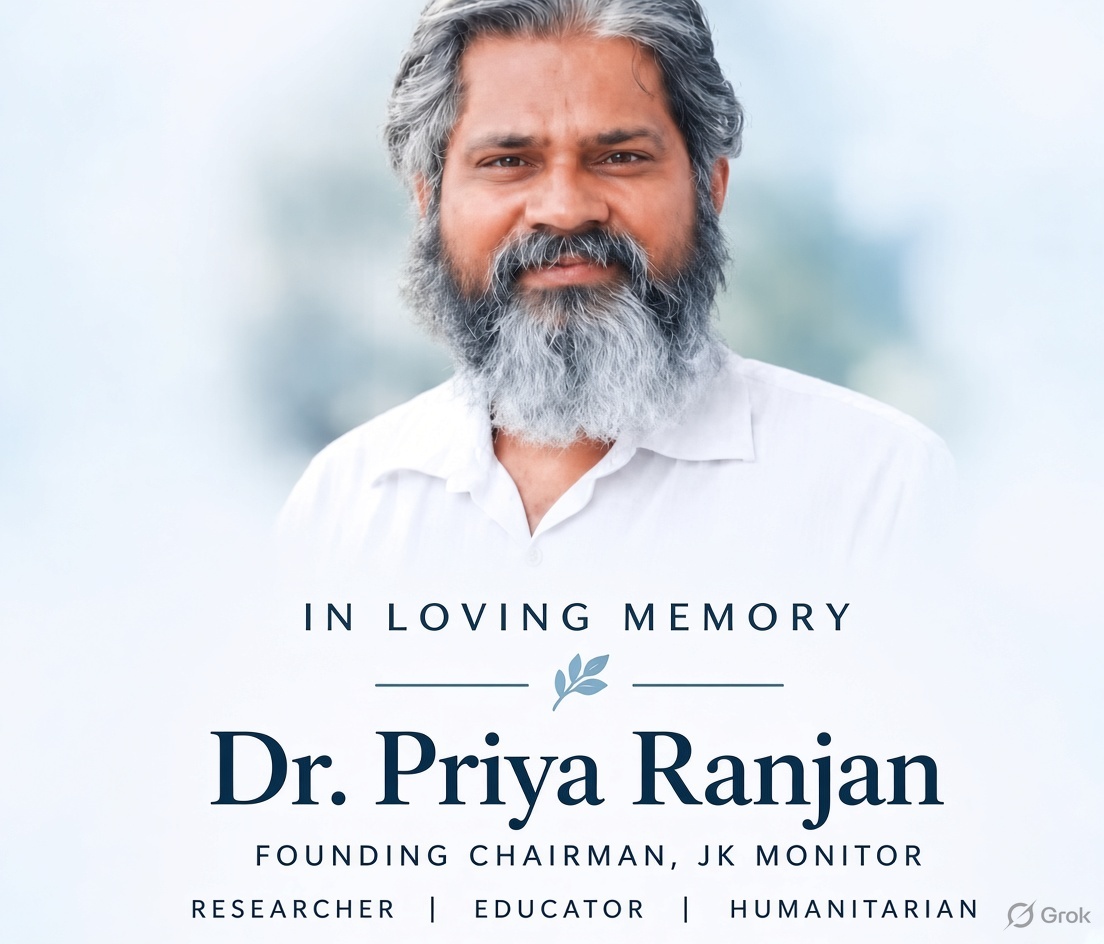 I will always remember Dr. Priya Ranjan not only as the Chairman of JK Monitor, but as a mentor, guide and elder brother whose kindness shaped my life and work. Write a tribute at
 Unlocking a ₹65,800 crore lending opportunity in India’s rural women micro and small enterprise (MSE) sector
- United Way Mumbai, Women’s World Banking, HSBC India and SIDBI’s convening to showcase a “for women, by women” credit delivery model and share the experiences of women entrepreneurs accessing formal finance.
- The Prayaas Individual Enterprise Scheme (IES) when rolled out through model community-based organizations today could unlock a ₹65,800 crore lending opportunity.
- Self-help group representatives discuss the success of Prayaas in delivering affordable, collateral free credit timely and for their business growth needs.
- The convening aimed at highlighting the role of public-private partnerships in building the social infrastructure needed to expand women’s economic opportunities and scale enterprise finance.
MUMBAI: United Way Mumbai (UWM), Women’s World Banking (WWB) and HSBC Indiahave come together to support 300,000 women in Maharashtra, Assam, and Bihar, by providing access to timely and affordable credit to enable and encourage growth of women MSEs in rural India. The initiative is being rolled out in close collaboration with Small Industries Development Bank of India and respective State Rural Livelihood Missions furthering enterprise creation and development.
A conveningwas organised in Mumbai to share learnings from the Small Industries Development Bank of India (SIDBI) Prayaas Individual Enterprise Scheme (IES) experience and explore pathways to scale enterprise credit for rural women. Prayaas is a “Credit for the women, by the women” model, that enables individual Self-Help Group (SHG) women to access collateral-free loans ranging from ₹50,000 to ₹2,00,000 through women-led community-based organisations (CBOs), which act as Partner Institutions responsible for sourcing, servicing, and collections.
The convening brought together representatives from national and state rural livelihood missions, such as the Maharashtra State Rural Livelihoods Mission (MSRLM), Mahila Arthik Vikas Mahamandal (MAVIM),CBOs, development partners, and women entrepreneurs to reflect on the journey of Prayaas and its potential to unlock the opportunity to improve access to affordable credit the growth of women MSEs in rural India.
A key highlight was hearing from women entrepreneurs and members of women-led SHG community institutions. They shared how timely formal credit, strengthened by business and financial management capabilities, has helped them grow their enterprises. Community representatives also highlighted how digital lending can improve access and efficiency while strengthening the long-term sustainability of their institutions.
Delivering the keynote, Shri Amit Shukla, Joint Secretary-NRLM, Ministry of Rural Development, said, “The Government has launched numerous measures to support women in transitioning from credit-linked livelihood activities to becoming owners of enterprises. Around 3.85 million women-led enterprises are seeking credit, representing a ₹12,388 crore opportunity in the ₹5 lakh to ₹20 lakh segment. Solutions such as Prayaas can help unlock this potential and advance the vision of Viksit Bharat 2047. I encourage all State Rural Livelihood Missions to partner in making Prayaas a national initiative for women-led enterprise growth.”
Shri Prakash Kumar, Deputy Managing Director, SIDBI, appreciated the role played by WWB, HSBC and UWM in facilitating institutional credit under IES to women micro enterprises. Speaking on the occasion, he said, “Prayaas has evolved into an innovative, gender-intentional model that combines the reach and trust of women-led community institutions with formal finance. Its expansion from one state to four demonstrates both the strength of the approach and its potential for scale. SIDBI is committed to expanding the IES by reaching out to a larger number of women micro enterprises through Cluster Level Federations and working with State Rural Livelihood Missions across India so that more women entrepreneurs can access timely and affordable credit for growing their enterprises.”
Looking at the response from the target segment, IES has since been regularised by SIDBI. SIDBI plans to expand IES in existing states as also widen the outreach to other states and is in discussions with various SRLMs.
Speaking of HSBC India’s association,Aloka Majumdar, MD and Head of Sustainability, HSBC India, said, “We are committed to expanding access to knowledge, capabilities, capital and networks for women entrepreneurs, which we believe are foundational to grow sustainable enterprises. Over the past decade, Government of India’s initiatives have accelerated financial inclusion by expanding access to bank accounts and digital payments, bringing formal finance closer to women. The next frontier of building financial capabilities will centre around enabling more women to use the financial system developed thus far, to build enterprises that generate income, create jobs and make our household and communities financially resilient.”
Speaking at the event, Kalpana Ajayan, Regional Head, South Asia, Women’s World Banking, said, “Prayaas shows how women-led community intelligence can strengthen formal lending and make rural women entrepreneurs more visible and bankable. As India’s apex financial institution for MSMEs, SIDBI’s vision and commitment to women-led micro and small enterprises can transform India’s journey towards inclusive economic empowerment. By placing women’s realities at the centre of credit delivery, Prayaas offers a viable, scalable model of finance for women, delivered by women.”
George Aikara, CEO, United Way Mumbai, said, “Prayaas demonstrates how trusted, women-led community institutions can connect rural women entrepreneurs to formal finance at scale. By combining local borrower knowledge with streamlined lending and capability building, the model creates an efficient, gender-intentional pathway to productive credit. United Way Mumbai remains committed to strengthening livelihoods, and this collaboration across government, industry, civil society, and community institutions is essential to address India’s interconnected challenges and advance inclusive progress.”
The convening highlighted that closing the rural women’s enterprise credit gap requires more than lending capital alone. It requires investment in the social infrastructure, distribution channels, institutional capabilities, and risk-sharing mechanisms that enable financial institutions to serve women entrepreneurs sustainably. The convening also underscored the role of public-private partnerships and CSR capital in strengthening these pathways, enabling innovation, generating evidence, sharing risk, and creating models that financial institutions can take to scale.
The model builds on high-performing CBOs within the National Rural Livelihood Mission (NRLM) ecosystem, leveraging their community trust, local intelligence, and understanding of borrower behaviour to make credit delivery more responsive. This creates a model of credit delivery “by women, for women”: borrower intelligence flows upwards through trusted community institutions, while capital flows downwards to women entrepreneurs.
The potential for this approach is significant. Based on NRLM data and Women’s World Banking research, approximately 29.5 million SHG women are anchored within “Model CBOs”, of whom an estimated 7.39 million are women entrepreneurs. Among these women, an estimated 64% — or 4.73 million women —require individual loans in the ₹50,000 to ₹500,000 range. With an average ticket size of ₹115,000 (US$1,400), this represents an estimated ₹65,800 crore (US$7.7 billion) lending opportunity.
-------------------------------------------------
HSBC India and Sustainability
HSBC India’s strategy to support sustainable economic growth, focuses on Community Investment (CSR interventions), Sustainable Operations, Sustainable Finance and Sustainability Risk.
The strategy is delivered through a combination of programmes, collaboration, and partnerships. We believe it requires a concerted effort between business, governments and other stakeholders on policies and programmes to support transition to a more sustainable future.
HSBC India
HSBC India offers a full range of banking and financial services through 34 branches across 22 cities. The Bank is at the forefront in arranging deals for Indian companies investing overseas and foreign investments into the country. HSBC is one of India's leading financial services groups, with over 47,000 employees in its banking, investment banking and capital markets, asset management, insurance, software development and global resourcing operations in the country. It is a leading custodian in India.
HSBC Holdings plc
HSBC Holdings plc, the parent company of HSBC, is headquartered in London. HSBC serves customers worldwide from offices in 56 countries and territories. With assets of US$3,438bn at 30 June 2026, HSBC is one of the world’s largest banking and financial services organizations.
About United Way Mumbai: For 24 years, United Way Mumbai (UWM) has turned philanthropic intent into verified, lasting change across causes, communities, and geographies throughout India. Guided by an international standard of practice as part of the global United Way network—which spans 36 countries and reaches 48 million people annually. UWM executes multi-faceted interventions across five principal focus areas: Education & Youth Opportunity, Healthy Community, Financial Security (including key enterprise credit programmes like Project Prayaas), Climate Action & Community Resiliency. UWM has invested INR 1352+1150+ Crores directly in community development projects, is the trusted CSR implementing partner for 300+ Corporates, has formed an extensive pan-India network of 500+ vetted Non-profits and has mobilised the goodwill of 1,00,000+Individual Donors in supporting transformative local causes. In the last half a decade alone, UWM has impacted the lives of 24,121,221individuals. Learn more about UWM: www.unitedwaymumbai.org
About Women’s World Banking (WWB): For over 45 years, Women’s World Banking has been dedicated to serving the 700 million women excluded by the formal financial sector. We partner with financial institutions and policymakers to design, develop and implement solutions and programs that facilitate systemic change for women. As an investor, we advance women in the workplace and as customers through direct equity - to bring them security, prosperity, and independence. Since 2018 Women’s World Banking has reached more than 118 million women and 76 million men, helping to change not only their lives but also of their households, communities, and countries. Learn more about how we make finance work for women: www.womensworldbanking.org
