

 Share your story and shine at JK Monitor!🌟 Welcome to JK Monitor, where every story matters and every achievement is celebrated! We invite you to share the remarkable journey of your life and showcase your accomplishments to the world. Join our exclusive interviews that honor exceptional individuals just like you.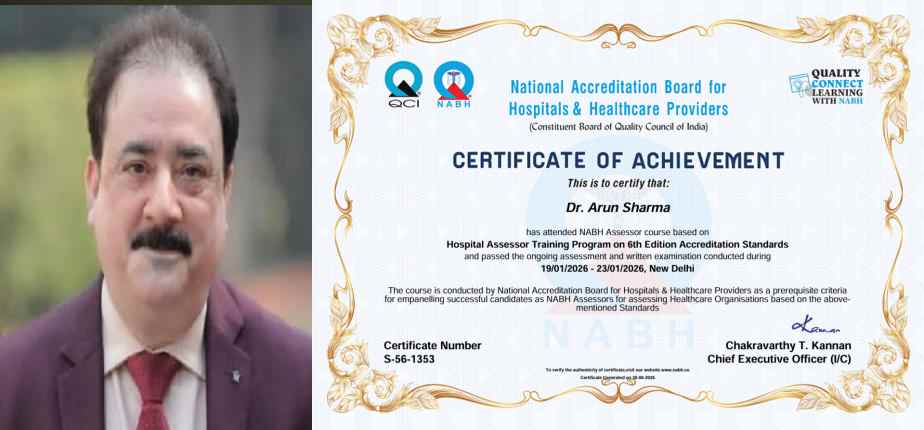
JAMMU: On occassion of Doctors day Dr. Arun Sharma has brought laurels to the Department of Health and Medical Education, Government of J&K, by becoming NABH Assessor (National Accreditation Board for Hospital and Healthcare Organizations) after qualifying the prestigious training and exam conducted by NABH Quality council of India and successfully completing two mandatory observerships.
Dr. Arun Sharma embarked on his journey on quality care for hospitals in 2016 after becoming the J&K state assessor for KAYAKALP. Kayakalp is an initiative launched by the Ministry of Health and Family Welfare, Government of India in 2015 to promote cleanliness, hygiene, and infection control in public health facilities.
It aims to incentivize and recognize top-performing facilities, fostering a culture of ongoing assessment and sustainable sanitation practices. Facilities are evaluated on six main themes: Hospital/Facility Upkeep, Sanitation and Hygiene, Waste Management, Infection Control, Support Services, Hygiene Promotion.
Three-Tier Assessment Process: The process involves internal, peer, and external (State) assessments to ensure thorough evaluation. High-performing hospitals (District Hospitals, CHCs, SDHs) receive monetary awards and recognition, encouraging continued excellence. Dr Arun Sharma has done assessment of facilities at Ladakh (Leh & kargil), Kashmir division and Jammu division.
In 2020, Dr Arun Sharma became a National (external assessor) (National Quality Assurance Standards) NQAS which is by National Health System Resource Centre, NHSRC, Ministry of Health and Family Welfare, MOH&F, Government of India GOI.
The National Quality Assurance Standards (NQAS) are a comprehensive framework implemented by the Indian Ministry of Health and Family Welfare to improve quality at public health facilities, including district hospitals, CHC / Sub District, UPHC's, PHC's and Ayushman Arogya Mandirs (AAM Sub centers).
They ensure services are safe, patient-centric, and meet high quality standards for services, infection control, and management. NQAS Covers 8 major areas: service provision, patient rights, inputs, support services, clinical care, infection control, and quality management.
Facilities are certified based on scoring (full compliance, partial, or non-compliance) and receive financial incentives.NQAS Assessment: Involves internal assessment, state-level assessment (SQAC), and national-level certification. NQAS certification is valid for three years, with regular surveillance audits. As of late 2024, over 16,500 health facilities in India have received NQAS certification. Dr Arun Sharma has done several Physical as well as virtual NQAS Assessment in various public facilities of India.
NABH, National Accreditation Board for Hospitals & Healthcare Providers, is a constituent board of Quality Council of India (QCI), set up to establish and operate accreditation programmes for healthcare organizations. Formed in 2005, it is the principal accreditation for hospitals in India.
The first edition of standards was released in 2006 and after that, the standards have been revised every 3 years. Currently the 6th edition of NABH standards, released in January 2025 is in use. The organization has to go for re-assessment after every 2 years. After every re-assessment, the renewal certificate is obtained by the hospital.
Dr Arun Sharma after MBBS from GMC Jammu did his post graduation in Hospital Administration and had been Medical Superintendent in various district hospitals and Medical College hospitals besides being State programme manager for National health mission J&K in his career of more than 32 years.
He is also a life member of CAHO (Confederation of accredited Health care organisation) and presently Chairperson for J&K. He is also a life member of Academy of Hospital Administration, AHA, India, and had been regional secretary, Jammu branch of AHA in the year 2024-25, when he was instrumental in organising more than. 25 MDP's (Management Development Programmes) for more than 3000 healthcare professionals in the state of J&K.
He is also a life member of RFHHA, IIPA New Delhi, IMA etc and many other organisations. His core interest towards introducing quality in hospitals made him realize the importance of becoming an NABH assessor.