

 Share your story and shine at JK Monitor!🌟 Welcome to JK Monitor, where every story matters and every achievement is celebrated! We invite you to share the remarkable journey of your life and showcase your accomplishments to the world. Join our exclusive interviews that honor exceptional individuals just like you.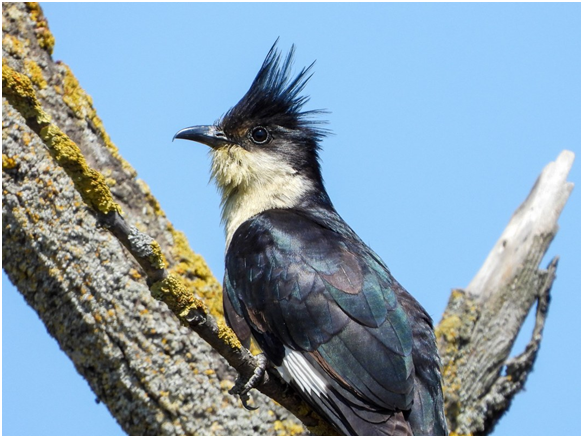
A striking Jacobin cuckoo perched on a sun-dappled branch, its sleek black crest fully raised in a proud, inquisitive crown. The bird's crisp black-and-white plumage catches the light, a contrast of slate-grey upperparts and pure white underbelly, while its sharp, dark eye looks skyward. A small caterpillar dangles from its beak, a hint of the seasonal feast the monsoon delivers.
Long before the first weather satellite blinked to life in the cold vacuum of space, long before supercomputers began crunching terabytes of atmospheric data, and long before the ubiquitous ping of a smartphone app could predict a coming downpour to the minute, the people of the Indian subcontinent looked to a far more ancient, more lyrical oracle.
That oracle was a bird — a slender, elegant creature cloaked in a dramatic ensemble of black and white, with a jaunty crest that it could raise into a proud, inquisitive fan. Its name, whispered from the deserts of Rajasthan to the coasts of Odisha, was the Chatak. To the modern ornithologist, it is Clamatorjacobinus, the Jacobin cuckoo, or simply the pied cuckoo. But to millions of farmers, poets and seekers across the subcontinent, it was, and remains, the monsoon forecaster — a winged harbinger whose very appearance, a sleek silhouette against the aching pre-monsoon sky, was once considered as sure a sign of imminent rain as any barometer reading.
As the parched earth cracks into deep, yearning fissures under the unrelenting summer sun, and the air grows so thick with humidity that it feels like a warm, wet blanket pressing down on the land, a singular, piercing call slices through the oppressive haze. Pee-oo, pee-oo, it rings out, a distinctive three-note whistle, rising slightly on the middle syllable before descending again. It is a sound that, for centuries, has stirred a profound and collective hope in the hearts of millions.
In the village square, the old farmer pauses in his work, tilts his head, and smiles. In the courtyard, a grandmother points towards the dense canopy of a mango tree, telling the wide-eyed children that the Chatak has spoken, and the rains are finally on their way. The bird is sleek, its back a glossy slate-grey that can appear black in certain lights, its underparts a brilliant, immaculate white that flashes as it takes flight. It is this crisp, almost tailored appearance — a bird dressed like a messenger in formal attire — that makes it so unmistakable.
For generations of agrarian communities across India, the arrival of the Chatak was a calendar more reliable than any printed almanac. It was a biological metronome that kept time with the great celestial cycles, an organic instrument tuned to the very pulse of the monsoon. When the first pied cuckoo was spotted on the outskirts of the village, elders would nod knowingly and tell the young men to sharpen their ploughs and ready their bullocks. The bird was not merely a signal; it was a promise, a tangible, feathered confirmation that the long wait for deliverance was nearly over.
The relationship between the bird and the rain was elevated, over centuries of oral tradition, to the stuff of pure legend. Deeply embedded folklore insists that the Chatak, parched and eternally principled, lives by a code of absolute purity. It refuses, the stories say, to drink even a single drop of water that has touched the earth.
Instead, it waits, its beak pointed devoutly towards the heavens, yearning for the first pristine, untouched raindrops to fall directly from the sky onto its waiting tongue. This mythical, unquenchable thirst transformed the bird from a simple biological entity into a powerful symbol of patience, of unwavering faith, and of a soul’s singular longing for a divine, untarnished source of life.
Today, as climate patterns grow increasingly erratic, as the romance of traditional ecological knowledge risks being drowned in a relentless deluge of data and screen notifications, a quiet revolution is underway. It is a revolution led not by politicians or pundits, but by citizen scientists, ecologists, and a handful of birds carrying tiny, solar-powered backpacks. This new wave of research is finally decoding the true, breathtaking story of Clamatorjacobinus. And what science is revealing, far from dispelling the magic, only adds a deeper, more profound layer of poetry to the ancient fable.
The Avian Orchestra of the Monsoon
The Chatak never sang its pre-monsoon aria in isolation. It was, rather, the lead vocalist in a vast, intricate orchestra of natural cues that the people of the subcontinent once knew intimately. The entire landscape would whisper, hum, and bloom in the run-up to the rains. The Amaltas, or golden shower tree, would erupt into cascades of brilliant yellow flowers so intense they seemed to drip liquid sunshine. Termites, sensing the shift in barometric pressure, would pour out of their mounds in frantic, winged nuptial flights, a protein bonanza that set every bird and lizard into a frenzy.
The bullfrogs, who had been lying dormant in the cracked mud, would suddenly find their voice, their deep, booming calls echoing across the newly formed puddles like a subterranean drumroll. But the pied cuckoo held a special, more mystical place in this natural calendar. Unlike the resident Asian Koel, whose rising, koo-Ooo call is a lazy, sweltering drawl that marks the peak of the heat, the Jacobin cuckoo is a long-distance migrant.
It does not belong to just one place. It is a global citizen. It breeds in the savannahs of sub-Saharan Africa, and around late May, a distinct, enigmatic population begins a journey of astonishing audacity. They launch themselves across the vast, inhospitable expanse of the Arabian Sea, riding the very wind currents that carry the monsoon clouds towards the Indian peninsula. They are not just predicting the rains; they are fellow travellers on the monsoon’s very breath.
The village chronicles of India are filled with the practical, lived lore of the Chatak. In the arid, historically drought-prone region of Bundelkhand, the sighting was treated with a reverence bordering on the sacred. “My father would call me to the edge of the field,” recalls 78-year-old Raghavendra Singh, a retired farmer whose hands still bear the deep, permanent calluses of a lifetime gripping a plough.
“He would point to the sky and say, ‘Look for the black-and-white bird. When you hear it calling from the top branch of the neem or the mango tree, do not wait another day. Sharpen the plough, check the seed drills, and be ready.’ He was a man who could not read a newspaper, but he could read the sky and the earth.
And he was never wrong. Within eight or ten days of hearing that whistle, the first heavy showers would arrive, turning the dust to mud and the brown fields to a carpet of green.” This deep, empirical knowledge, sharpened over centuries of patient observation passed down through generations, did more than just predict the weather. It bound human communities to the rhythm of the seasons in a pact that was as much spiritual as it was agricultural.
In the realms of classical Sanskrit, Pali, and vernacular poetry, the Chatak is a persistent, heart-wrenching metaphor for viraha — the profound, painful longing of a separated lover, or the spiritual yearning of the soul for union with the divine.
The 15th-century mystic poet-saint Kabir, and long before him the great Sanskrit playwright Kalidasa, repeatedly invoked the bird’s legendary thirst to illustrate the concept of bhakti. The Chatak, rejecting the water of the world, is the spiritual aspirant who refuses all lesser, temporal satisfactions, waiting solely for the grace of God to fall like pure rain.
In the Meghaduta, Kalidasa’s lyrical masterpiece, the exiled Yaksha begs a passing cloud to carry his message to his beloved, drawing a direct parallel between the cloud’s journey and the life-giving monsoon that the Chatak awaits with such fervent, open-beaked devotion. The bird was thus a living embodiment of a profound philosophical truth: that ultimate deliverance comes from the sky, from a source beyond the mundane world. This belief neatly, almost perfectly, aligned with the stark agricultural reality of a subcontinent where the lives of a hundred million people depended, year after year, on the arrival of the celestial tap.
Decoding the Myth with the Tools of Science
The notion that the Chatak is a true jal-abstinent, surviving only on airborne raindrops, is, of course, a beautiful and evocative fable. Ornithologically, the bird is a practical creature that happily drinks water from ponds, puddles, and birdbaths just like any other winged visitor to a garden. But the mesmerising kernel of truth at the heart of the myth is the truly spectacular synchronicity of its migration with the monsoon’s advance across the Indian landmass.
This overlap is no random coincidence; it is a masterstroke of evolution. The Jacobin cuckoo’s arrival on Indian soil is timed with clockwork precision to exploit a protein bonanza unleashed by the very first rains: a sudden, teeming bloom of caterpillars, moths, grasshoppers, and other large, juicy insects that emerge to feast on the explosion of fresh vegetation.
The bird is also a quintessential brood parasite, infamously laying its eggs in the nests of unsuspecting foster parents, chiefly babblers of various species. The monsoon-triggered breeding boom among these host species provides a veritable conveyor belt of nests and unwitting foster parents precisely when the cuckoo needs to offload its parental duties. The bird’s entire reproductive strategy is a bet on the monsoon, and it is a bet that evolution has honed to perfection.
The question then arises: does the bird actually “forecast” the monsoon in a predictive sense, or is it merely a fellow traveller, an exquisite piece of driftwood carried on the same mighty river of air? Scientists gently but decisively reframe the narrative. The cuckoo does not predict the monsoon; it reveals it. Its arrival is a biological confirmation of a massive, already-in-motion atmospheric process.
“The bird is riding the Somali Jet, a powerful, low-level, cross-equatorial wind flow that is the very engine of the Indian monsoon,” explains Dr. Suhel Quader, an evolutionary ecologist who has been deeply involved with long-term studies on the species through the Nature Conservation Foundation.
“The Somali Jet is formed by the temperature gradient between the Asian landmass and the cooler Indian Ocean. It’s a river of wind screaming across the Arabian Sea. When you see the first pied cuckoos arriving on the western coast, it is tangible, living proof that this atmospheric machinery is already churning, that the monsoon system is active and is, quite literally, on its way to your door. The bird is an indicator species, a biological signal that the large-scale weather system is not just a forecast on a screen but a physical reality sweeping towards you.”
This scientific distinction hardly matters to the lyrical eye of the poet or the grateful gaze of the farmer. The bird remains a tangible, feathered confirmation of an invisible, vast, and abstract force, making the impersonal physics of the weather forecast a living, breathing, emotionally resonant event in the backyard.
Backpacks, Satellites, and a Bird Named Megh
In the last decade, the entire arcane mystery of the pied cuckoo’s transoceanic journey has been brilliantly illuminated by a pioneering citizen-science initiative: the MigrantWatch project, a collaborative effort spearheaded by the Nature Conservation Foundation and scientists at the Indian Institute of Science. By synthesising two powerful streams of data — thousands of meticulous sightings logged by an army of amateur birdwatchers logging their “first bird of the season” from Kerala to Kashmir, with cutting-edge satellite telemetry — researchers have finally managed to stitch together the cuckoo’s astonishing itinerary.
The jewel in the crown of this research was an ambitious experiment that seemed straight out of science fiction. Scientists captured a handful of Jacobin cuckoos on their Indian breeding grounds and fitted them with tiny, custom-built satellite tags. These devices, weighing less than a few grams and powered by miniature solar panels, were affixed like tiny backpacks, resting comfortably on the bird’s lower back, secured by soft Teflon harness loops that did not impede flight.
The data these avian spies beamed back to the researchers’ computers was nothing short of breathtaking. It painted a picture of endurance, navigation, and ecological synchrony that humbles human engineering. The tags showed that after their breeding season in India, the cuckoos embarked on an epic return migration.
They did not just flutter out to sea; they climbed into the sky and intercepted the wind systems, crossing the entire vast, unforgiving expanse of the Arabian Sea, often in a single, non-stop, gruelling flight that could last several days and nights. Their target was their wintering grounds in the acacia-studded savannahs of East Africa, primarily in regions of Kenya, Tanzania, and Somalia.
There, they would spend months, their lives intertwined with the rhythms of a different continent. Then, as the Northern Hemisphere spring tilted the earth towards the sun, they would sense the precise, intricate combination of celestial and environmental cues — the changing length of the day, the position of the stars, the subtle shifts in wind patterns — to launch themselves back into the sky, retracing their transcontinental flight to perfectly intersect with the onset of the southwest monsoon over the Indian subcontinent.
One particular bird, affectionately named “Megh” — the Sanskrit word for cloud — by the researchers, became a minor celebrity in scientific circles. The data from Megh’s tiny backpack traced a magnificent, curving 5,500-kilometre arc from a scrub forest in northern India, out over the glinting Arabian Sea, and right down to the arid landscapes of Somalia, revealing migratory corridors that had been speculated about by naturalists for over a century but never empirically proven.
This synthesis of cutting-edge satellite technology and ground-level, grassroots enthusiasm has not only demystified an ancient fable but has also provided a crucial ecological baseline for the future. By meticulously tracking even subtle shifts in the bird’s arrival dates on the subcontinent, year upon year, scientists can now use the pied cuckoo as a feathered biosensor of immense value, monitoring in real-time how climate change is beginning to tug and pull at the tightly woven, delicate fabric of the monsoon cycle.
A late cuckoo in a single year is a curiosity. A statistically significant, decade-long trend of later arrivals could signal a far deeper and more dangerous disruption in the wind patterns that sustain the lives and livelihoods of over a billion people. The bird, once a farmer’s simple charm, has become a sentinel for the Anthropocene.
A Messenger in a Time of Amnesia
The romance of the Chatak stubbornly persists in Indian popular culture, from classic Bollywood songs that yearn for the rain, to the flurry of excited social media posts that erupt every late May when someone spots the first pied cuckoo of the season. The hashtag #Chatak briefly trends, a digital echo of the village elder’s nod. Yet, there is a quiet, creeping poignancy to this enduring fascination.
As weather apps deliver instantaneous, hyper-local, colourful radar imagery to every palm, the nuanced, patient art of reading nature’s living signs is rapidly fading from the farm and, more worryingly, from the collective memory. The pied cuckoo’s iconic whistle is now, for many, just a fleeting, barely noticed sound against the overwhelming backdrop of urban traffic noise, unheard by entire generations who never learned, or were never taught, to stop and listen to the language of the living world.
Yet, the bird carries on, its ancient, inherited internal compass undeterred by the changes unfolding on the ground below. It remains a profound and deeply moving symbol of continuity, a living thread that links the immensity of the African savannahs, the treacherous, glinting expanse of the Arabian Sea, and the eager, waiting fields of a village in Madhya Pradesh.
It reminds us, in a way that a satellite image cannot, that the monsoon is not just a meteorological event, a statistical departure from a long-term average. It is a grand, sweeping, biological pulse that orchestrates life, movement, and renewal across continents. The Chatak’s arrival, its piercing three-note call cutting through the thick air of a summer afternoon, is a timeless, embodied reminder.
It tells us that long before we could ever predict the weather with our models and our machines, we could observe it, feel it, smell the ion-charged air, and hear it arriving on the outstretched, trembling wings of a small, brave, and exquisitely beautiful bird, a bird still yearning for the same life-giving downpour that we, too, wait to soak our parched fields, to fill our wells, and to quench our collective, ancestral soul.