

 Share your story and shine at JK Monitor!🌟 Welcome to JK Monitor, where every story matters and every achievement is celebrated! We invite you to share the remarkable journey of your life and showcase your accomplishments to the world. Join our exclusive interviews that honor exceptional individuals just like you.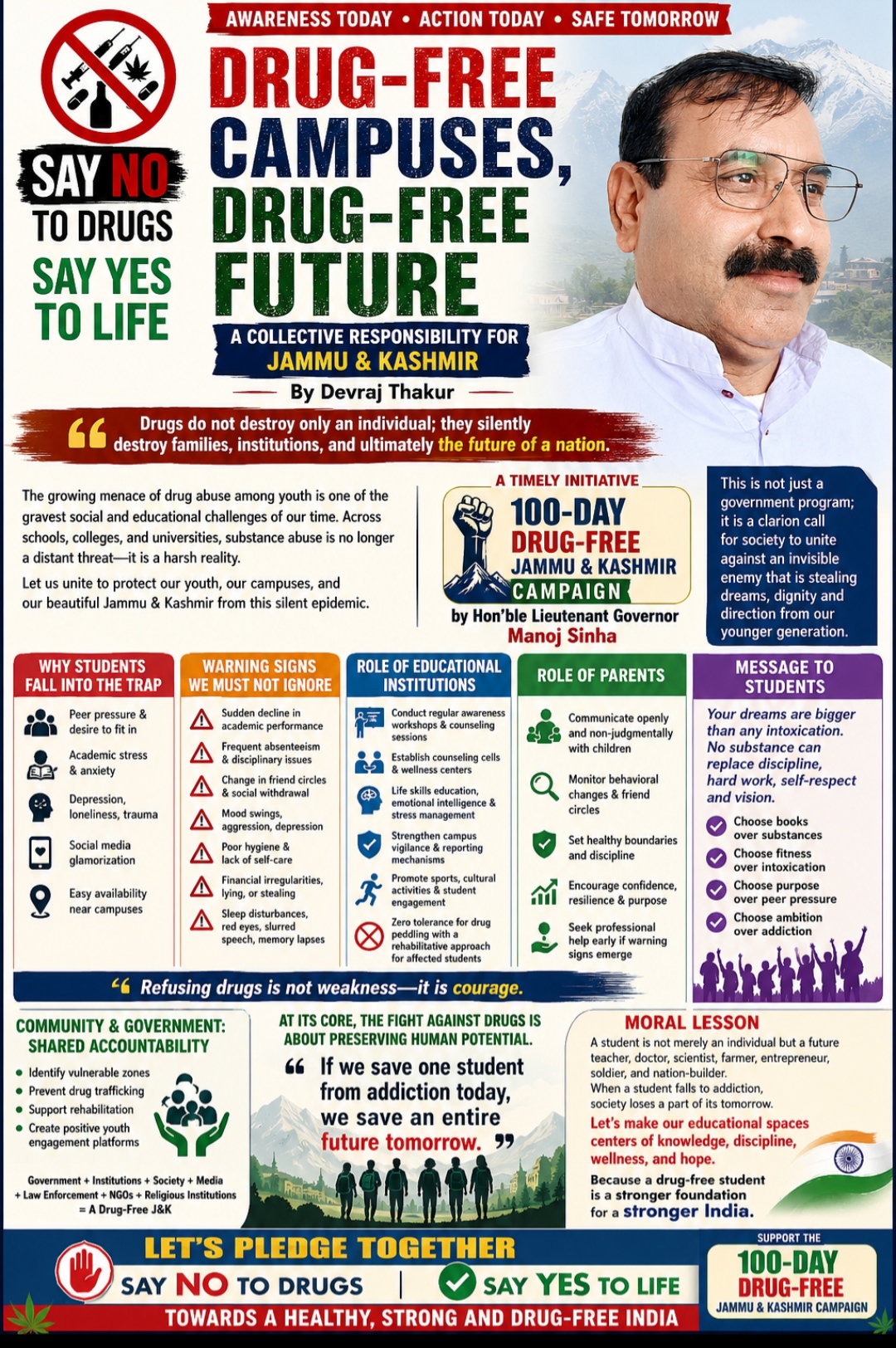
“Drugs do not destroy only an individual; they silently destroy families, institutions, and ultimately the future of a nation.”
The growing menace of drug abuse among youth has emerged as one of the gravest social and educational challenges of our time. Across schools, colleges, and universities, substance abuse is no longer a distant threat—it is a harsh reality knocking at the doors of classrooms, hostels, playgrounds, and even homes. In a region like Jammu and Kashmir, known for its rich cultural heritage, intellectual traditions, and resilient youth, the rise of drug addiction among students is deeply alarming.
The recent inauguration of the 100 Days Drug-Free Jammu & Kashmir Campaign by Hon’ble Lieutenant Governor Manoj Sinha is a timely and commendable intervention. This initiative is not merely a government program; it is a clarion call for society to unite against an invisible enemy that is stealing dreams, dignity, and direction from our younger generation.
Drug abuse refers to the harmful or inappropriate use of legal or illegal substances, including prescription medicines, tobacco, alcohol, cannabis, synthetic drugs, and narcotics. What begins as experimentation, peer pressure, curiosity, or temporary escape from stress often turns into addiction—a chronic disease affecting the brain, judgment, emotions, and social behavior.
Educational institutions, which should be sanctuaries of learning and character building, are increasingly becoming vulnerable spaces where students are exposed to unhealthy influences. The pressure to excel academically, emotional instability, broken family communication, unemployment anxiety, social media glamorization, and toxic peer groups have made many adolescents psychologically fragile.
Young brains continue developing until their mid-twenties. Drug use during this critical phase damages decision-making capacity, weakens concentration, impairs memory, and increases impulsive behavior. A student under addiction does not merely lose marks; they gradually lose identity, self-worth, relationships, and life goals.
“Addiction promises relief but delivers ruin.”
Several factors contribute to drug abuse among students:
Desire to fit into peer groups
Curiosity and thrill-seeking behavior
Academic pressure and competition
Depression, anxiety, loneliness, and trauma
Family conflicts or lack of parental supervision
Easy availability of drugs near campuses
Social media glorification of substance use
Many students wrongly believe substances enhance concentration, confidence, or performance. In reality, drugs offer temporary illusion while silently dismantling mental and physical health.
Parents, teachers, and peers should remain alert to the following signs:
Sudden decline in academic performance
Frequent absenteeism and disciplinary issues
Change in friend circles and social withdrawal
Mood swings, aggression, irritability, or depression
Poor hygiene and lack of self-care
Financial irregularities, lying, or stealing
Sleep disturbances, red eyes, slurred speech, memory lapses
Ignoring these signals is like watching smoke and denying the possibility of fire.
Role of Educational Institutions: From Awareness to Action
Schools and colleges must adopt a whole-institution approach toward prevention.
Institutions should:
Conduct regular anti-drug awareness workshops and counseling sessions
Establish active counseling cells and wellness centers
Introduce life skills education, emotional intelligence, and stress management programs
Strengthen campus vigilance and reporting mechanisms
Promote sports, cultural activities, and student engagement initiatives
Build zero tolerance for drug peddling while maintaining a rehabilitative approach for affected students
Drug prevention cannot be reduced to one seminar or poster campaign. It must become part of institutional culture.
“A campus that ignores addiction is indirectly nurturing destruction.”
Parents must understand that prevention begins at home.
Parents should:
Communicate openly and non-judgmentally with children
Monitor behavioral changes and friend circles
Set healthy boundaries and discipline
Encourage confidence, resilience, and purpose
Seek professional help early if warning signs emerge
A child who feels heard at home is less likely to seek escape elsewhere.
To students, the message is simple and urgent:
Your dreams are bigger than any intoxication. No substance can replace discipline, hard work, self-respect, and vision.
Say no to experimentation disguised as “fun.” Refusing drugs is not weakness—it is courage.
Choose:
books over substances
fitness over intoxication
purpose over peer pressure
ambition over addiction
“One wrong habit can erase years of hard work.”
Community and Government: Shared Accountability
Drug abuse cannot be tackled by government machinery alone. Society must participate.
Community leaders, NGOs, law enforcement agencies, religious institutions, and civil society organizations must collaborate to:
identify vulnerable zones,
prevent drug trafficking,
support rehabilitation,
create positive youth engagement platforms.
The 100-day awareness campaign launched under the leadership of Lieutenant Governor Manoj Sinha should become the foundation of a long-term social movement.
At its core, the fight against drugs is not only about law enforcement; it is about preserving human potential.
A student is not merely an individual but a future teacher, doctor, scientist, farmer, entrepreneur, soldier, and nation-builder. When a student falls to addiction, society loses a part of its tomorrow.
“If we save one student from addiction today, we save an entire future tomorrow.”
Let us pledge collectively—students, parents, teachers, institutions, and policymakers—to make educational spaces in Jammu and Kashmir centers of knowledge, discipline, wellness, and hope.
Because a drug-free student is not just a healthy individual—he or she is a stronger foundation for a stronger India.
Say No to Drugs. Say Yes to Life.
This article is a wake-up call that we must face this abhorrent phenomenon. Hopefully, others will join me in the campaign against this epidemic, whether on social media platforms, newspapers, television, or other media channels. This threat is immense, for the present as well as the future.
(The author Devraj Thakur is National Joint Secretary, Akhil Bhartiya Rashtriya Shakshik Mahasangh – Delhi India), Contact @ drthakur868@gmail.com