

 Share your story and shine at JK Monitor!🌟 Welcome to JK Monitor, where every story matters and every achievement is celebrated! We invite you to share the remarkable journey of your life and showcase your accomplishments to the world. Join our exclusive interviews that honor exceptional individuals just like you.
- One-day conference brings together farmers, scientists, judges and activists to chart safer, diversified agriculture and environmental mitigation for development projects
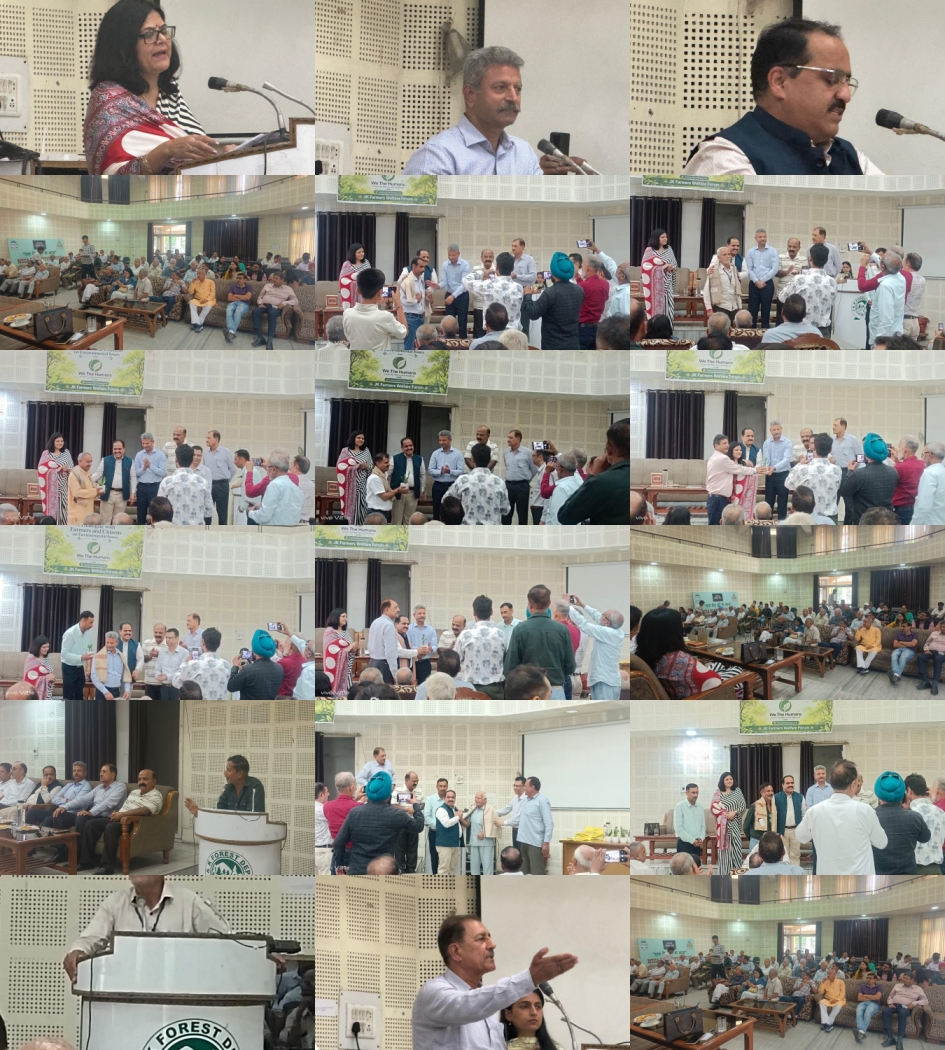 JAMMU: We The Humans Forum for Nature and Mankind, a public charitable trust, today organised a one-day conference of farmers and citizens at Forest Media Centre Vikram Chowk Jammu to address escalating environmental and public-health challenges linked to intensive agrochemical use and rapid infrastructural expansion in Jammu and Kashmir.
The event, held on September 13, 2026, featured R S Jasrotia, District and Sessions Judge, as chief guest, with Prof Rajinder Peshin (Retd Director Education, SKUAST Jammu), Samardev Singh Charak (Secretary, Dogra Educational Trust) and social activist-author Meenu Ajay Sawhney as guests of honour.
Speakers warned that J&K now records about 3.69 kg of chemical pesticides per hectare, far above Punjab and Haryana (~0.62 kg/ha), Himachal Pradesh (~0.50 kg/ha) and the national average (~0.22 kg/ha), making it one of India’s most pesticide-intensive regions. They linked excessive and often unsafe agrochemical use to rising cases of cancer, chronic kidney disease, brain tumours and neurological disorders among farming communities, and called for an urgent shift to natural farming, integrated pest management and disease-resistant crop varieties.
Capt Lalit Sharma (IFS, Retd), Vice Chairman, and K Y S Manhas, Chairman of the trust, highlighted parallel threats to water bodies and tree cover, noting that rivers and lakes including the Jhelum, Wular, Dal, Tawi, Devika and Basanter are shrinking due to encroachments and pollution from municipal waste, untreated sewage, heavy metals and toxic chemicals. They also cited large-scale felling of indigenous trees for ring roads, highways and expressways, urging the UT government to implement concrete environmental-mitigation plans and plant at least ten lakh native trees along the ring roads of Jammu and Srinagar as compensation.
Prof Sadiq Nargal, a leading food technologist, stressed the need for safe agriculture and a contamination-free food chain. Prof (Dr) Sanjay Khajuria (Head, KVK Samba) and Balkar Singh (President, Bhartiya Kissan Sangh, J&K) encouraged farmers to adopt modern techniques and crop diversification, including high-density mangoes, jackfruit, strawberry, dragon fruit, litchi, exotic vegetables, turmeric and ginger, while reducing hazardous agrochemicals.
The conference showcased on-ground success stories. Anshuman Singh, described as a “living legend” of J&K, shared his experience of visiting nine countries to learn innovative farming; his Bajalta farm now demonstrates dragon fruit, export-quality strawberries, Kesar and Alphonso mangoes, organic turmeric, blueberry cultivation and high-value exotic vegetables alongside agri-tourism. Reva Rajput, Director of Devi Pindi FPO Ltd, recounted building a small organic processing unit into a branded, pan-India marketed enterprise that now earns her over ₹1 lakh per month, urging farmers to become agri-entrepreneursSeveral progressive farmers who have adopted safe agriculture, diversified cropping and agri-tourism were honoured with shawls.
We The Humans Forum for Nature and Mankind is a public charitable trust dedicated to restoring degraded human values and repairing environmental damage caused by unsustainable growth, development and the side effects of chemical-intensive agriculture.

