

 Share your story and shine at JK Monitor!🌟 Welcome to JK Monitor, where every story matters and every achievement is celebrated! We invite you to share the remarkable journey of your life and showcase your accomplishments to the world. Join our exclusive interviews that honor exceptional individuals just like you.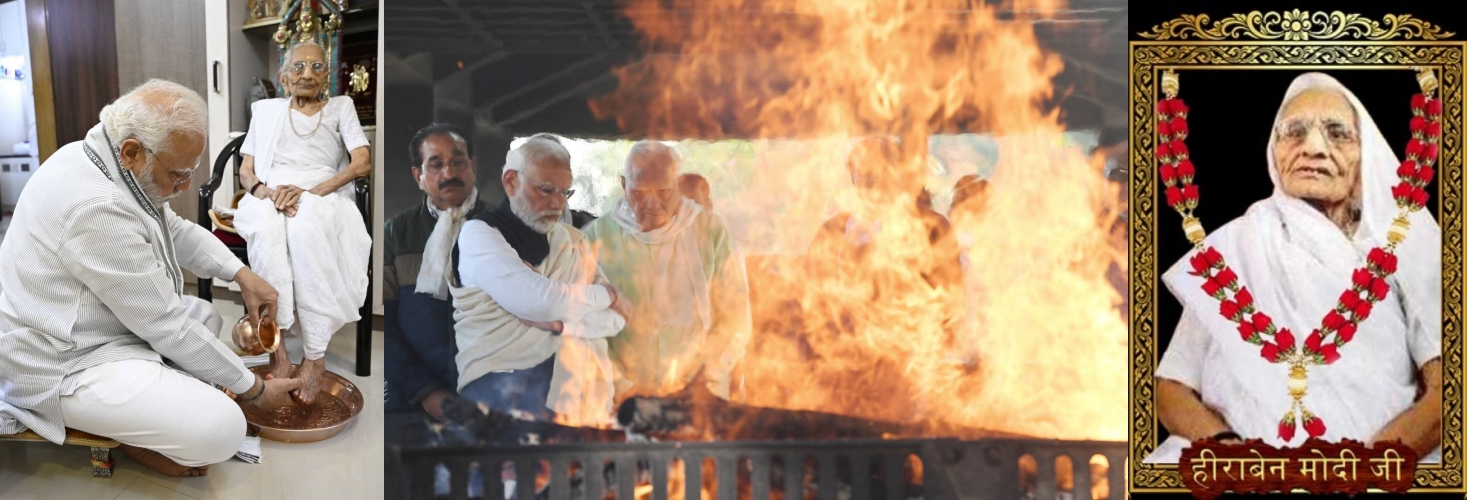
 To remember the mother of Prime Minister of India Narendra Modi is to step away from the usual language of public memory. It is not a task suited to timelines, milestones, or ceremonial praise. Instead, it invites reflection on something more subtle and enduring: how moral lives are formed long before political lives begin, and how private worlds quietly shape public destinies. MAA Heeraben Modi did not belong to the realm of public action, yet her influence cannot be understood as marginal. She represents a moral presence rather than a historical figure—a presence that worked silently, steadily, and without any concern for recognition. Her life reminds us that the foundations of leadership are often laid far from institutions of power.
She belonged to a generation of Indian women whose lives were defined by responsibility. Their authority emerged from daily conduct—how they worked, endured, and held themselves together in ordinary circumstances. Such authority rarely leaves records, yet it leaves marks.
Restraint was central to her way of being. Even when the world around her changed in extraordinary ways, she did not seek attention or advantage. She did not step into public space simply because it became available. In a time when proximity to power often reshapes personal identity, this refusal to transform oneself into a public symbol is itself a moral act.
Indian civilisational thought has long recognised that moral education begins in observation. Values are learned through atmosphere. Children absorb what they see repeated—how hardship is met, how labour is respected, how dignity is preserved in moments of scarcity. MAA Heeraben Modi’s life reflected an ethic in which work was a condition of dignity. Labour was neither glorified nor resented; it was accepted as necessary and meaningful. Such an ethic trains the mind to see effort as natural and complaint as unnecessary. Scarcity, when lived without grievance, produces a particular moral balance. It teaches endurance without bitterness and ambition without entitlement.
One learns to accept limits without surrendering self-respect. This balance becomes especially important later in life, when authority and power enter the picture. This emotional steadiness is visible in Narendra Modi’s public temperament. Familiarity with difficulty without carrying resentment is not a political stance. It is a personal disposition shaped early. It allows engagement with power without insecurity and decision-making without constant self-justification.
Equally important was the discipline of affection. Care existed, but it did not dissolve into indulgence. Support was present, but it did not become dependence. Such emotional boundaries prepare individuals to stand alone, to take responsibility, and to accept the weight of consequence. In public life, this inner stability often matters more than technical skill. Politics tests not only intelligence but endurance. Those who lack emotional grounding are often consumed by either fear or excess. Those who possess it are able to endure both praise and criticism without losing balance. Contemporary political culture rewards visibility, speed, and constant assertion. In such an environment, the imprint of quiet moral training becomes especially noticeable. It shows itself in patience, routine, and a certain resistance to distraction. These are not strategies; they are habits.
MAA Heeraben Modi’s life challenges modern assumptions about influence. Today, influence is measured by platforms and reach. Her example reminds us that the deepest influence may never be seen. Moral authority does not announce itself; it settles into character. There is also something deeply democratic about such a life. She accepted circumstance without surrendering dignity. This acceptance without submission tempers ambition and restrains ego. Such grounding is essential in a democracy, where leaders are constantly tempted to personalise power. When ambition is not moderated by humility, authority turns brittle.
When it is grounded in restraint, power becomes more durable. Her story also shifts our understanding of leadership formation. Leaders are shaped in homes where values are repeated daily as habits. These homes rarely enter public memory, yet they quietly shape public outcomes. The nation celebrates leaders, as it should. But it seldom pauses to acknowledge the moral ecosystems that produce them. Mothers like Mata Heeraben Modi are part of that unseen architecture—correcting, supporting, and guiding without expectation of return.
Seen through this lens, the Prime Minister’s emphasis on discipline, dignity of labour, and restraint appears less like political messaging and more like inherited ethics. Such values are carried forward, often unconsciously. Her continued simplicity, even when her son occupied the highest office, reinforces a crucial lesson: power does not have to transform personal values. One can remain rooted while standing at the centre of attention, provided those roots are deep.
This understanding reshapes the idea of legacy. Legacy is not always institutional or visible. Sometimes it is moral—passed quietly across generations and expressed through conduct rather than memory. In remembering MAA Heeraben Modi, we are invited to slow down and listen to quieter truths. About duty performed without applause. About endurance without bitterness. About moral steadiness without display. These truths sustain societies. They shape leaders long before those leaders speak in public. Behind every public life stands a private world that made it possible. On her death anniversary, we remember a moral presence whose quiet influence continues to shape the republic in subtle, enduring ways.
(Author is Professor and Chairman of Centre for NAMO Studies (CNMS). Email : modistudies@gmail.com)