
- Details
- Written by: Bilal Bashir Bhat
- Category: ENVIRONMENT
 Nature provides a multitude of benefits to humans such as control of crop pests by their natural enemies or crop pollination by animals. These functions are known as ecosystem services and are of crucial importance for agricultural and horticultural production. Since then agricultural intensification has successfully increased food production, following the steadily increasing demand due to human population growth. However, the intensification of agricultural production in recent decades has led to a decline and loss of biodiversity due to increasing use of chemical fertilizers,pesticides,
J&K State is well known for its Agriculture and horticultural produce both in India and abroad. The state offers good scope for cultivation of horticultural crops, covering a variety of temperate fruits like apple, pear, peach, plum, apricot, almond, cherry etc. Apart from this, well known spices like saffron and black zeera are also cultivated in some pockets of the state. There are around 7 lakh families comprising of about 33 lakh people which are directly or indirectly associated with horticulture. All these crops are dependenter on pollination by insects for good fruit quality and production.
Apples are highly dependent on bee pollination like other fruit crops. Throughout the world there is a serious deficit of pollinators worldwide and its foot prints are also seen in our valley. Low percentage of people in Kashmir understands the process of pollination and its importance. It is essential to up scale the capacity of various stakeholders concerned with crop production in Kashmir.
Pesticide" is a general term used for a chemical designed to kill target pests such as insects (insecticide), mites (miticide), weeds (herbicide) and organisms which cause plant diseases such as bacteria (bactericide) and fungi (fungicide). To reduce loss due to pest attacks and diseases, the fruit growers use almost every types of pesticides namely; synthetic Pyrethroids, Endosulphan, Chloropyrephos, Carbaryl, Demicron, Quinalphos, Monocrotophos etc and fungicides namely; Dithane, Mencozeb, Carboxin, Captan etc often these are sprayed without proper care. Pesticides and fungicides have unintended fall out on the natural insect and birds population which plays an important role in pollination process.
Over the years the use of pesticides in jammu and kashmir is increasing treamdously. People are using these pesticides to kill the pests and increasing their production. Indiscriminate use of pesticides in modern agriculture has disturbed the ecological inter-relationship by massive killing of farmer friendly insects along with detrimental insects. The culling of the pollinizer varieties and monoculturing of only Red Delicious cultivators further adds to the pollination problem in the state. In a season a single farmer uses 8-9 pesticide/Fungicide sprays in their orchids and there are thousands of such farmers in J&K, so think how much pesticide sprays are used by these farmers. During cultivation and after spending lakhs of rupees, the production and quality is not so much as expected. The reason is only that proper pollination does not occur during blossom period due to the lack of pollinators..
The economic survey report of 2015-16 notes that the consumption of pesticides and fungicides has increased manifold. Horticulture and agriculture activities involve more that one million people directly or indirectly in Jammu and Kashmir. In J&K, pesticides coupled with other input technologies have resulted in enormous increase in the agricultural productivity over the years. However, indiscriminate use of these chemical pesticides has increased not only the cost of production but also many human health hazards and environmental contaminations.
The state of Jammu & Kashmir tops in the intensity of pesticides application with an average level of 2.337 kg/ha, followed by Punjab (1.377kg/ha) and Haryana (1.151 kg/ha) (2013). For the year 2016 around 146.59 mt per year of pesticides were used in J&K.
The excessive use of pesticides in apple orchards is causing a great threat to lives of people. Not only human beings are suffering from various ailments due to use of pesticides but the animals 9too are at risk. The fodder obtained from apple orchards has lot of pesticides in it as the chemical spray done on trees falls on the ground thus contaminating the green fodder. Even the milk produced from cows is infected with pesticides. Earlier apple growers used to spray chemical pesticides twice or thrice a year, now 12 to 13 such sprays are being done on the apple trees.
Unfortunately, many agricultural pesticides may be toxic to pollinators like bees, insects, wasps etc and too for Humans. Each year many honey bee colonies and other insect population are damaged or destroyed by pesticides, primarily insecticides. Such losses have a devastating impact on the Pollination process and inturn the fruit production which automatically impacts the lives of people which are directely or indirectly involved with this sector. Growers of most insect-pollinated crops (apples, Pear, almonds and many others) experience lower yields, and ultimately the consumer must pay higher food prices. During the past two decades, there has been as substantial increase in the use of pesticides in terms both of volume and value. Most pollinators killing occurs when pesticides are applied or allowed to drift on to flowering crops or weeds.
Pollination is an essential ecosystem service which involves symbiosis between cultivar, pollinizer and the pollinator. Effective pollination results in increased quality fruit production. Pollinators are animals that mediate the exchange of pollen between flowers, facilitating fruit and seed production in roughly 88% of flowering plants. While a broad range of animal taxa can function as pollinators, bees, wasps, and other insects are uniquely specialized for pollen transport and account for the bulk of pollination services in both wild and cultivated plants, complemented principally by other insect pollinators.
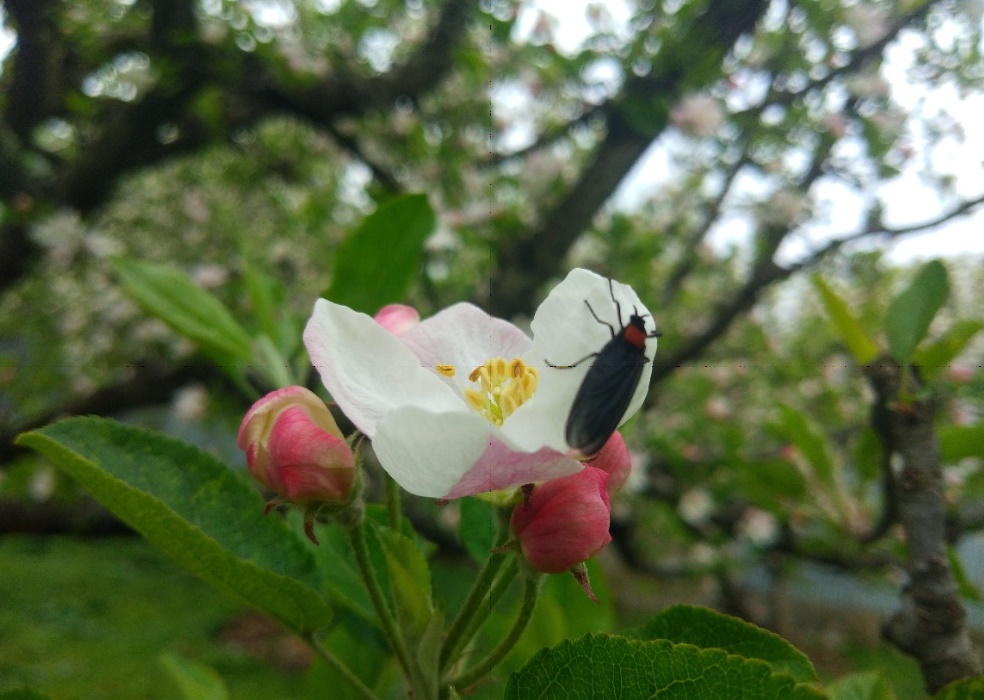 Approximately 90 percent of all flowering plants require pollinators to survive. The Rs 4,000 crore apple in J&K industry is allegedly the worst hit. Contact pesticides are usually sprayed on plants and can kill bees and other insects when they crawl over sprayed surfaces of plants or other areas around it. I am myself witness that whenever I visiting apple orchids during blossom period I see thousand of house bees and other insects in these orchids and now I hardly see any insect in these orchids during blossom period. The result of decasering of these colonies are only due to the indiscriminate use of pesticides especially the insectesticides used for increasing crop production.
Now people are spending thousands of rupees on airtifical pollination process like using of Plant growth hormones during blossom periods for better yields but the results are negeabale. To safeguard the Rs 400 crore apple industry and other fruits crops in J&K the role of these pollinators are very crucial and conservation of these is of utmost important.
Researchers, scientist, planners, etc should join their hands with farmers regarding how to tackle these problems. They should make an effort collectively with farmers how to reduce environmental pollution and how to minimize the use of chemicals in their farming system. The indiscriminate use of pesticides in our orchards are warming signals that we should reduce the chemical use and adopt biological and organic methods of controlling agricultural enemies, which are not only safe for these pollinators, the environment but for humans too....
- Integrated Forecasting System, river morphology for Jhelum, Tawi being worked on, HMAP submitted to the WB
- Dy Mayor oversees sanitization works at Lal Bazar
- Dy Mayor monitors sanitization drive in Downtown Srinagar, Jamia Masjid
- Desilting of main canals in Jammu region completed substantially; water to be released by April end
- DM B’la cracks down on 'Illegal Excavation’
- Houseboat Policy approved for Dal, Nigeen Lake
- Drive to axe Female Russian Poplars in Pulwama begins
- Russian Poplar tree felling allergy responsible or ecological catastrophe in Kashmir
- Drive for axing FRP tress begins in Shopian
- Cutting all Russian poplar trees would be economic, ecological disaster: CPI (M)
- LAWDA demolishes 3 illegal structures in Srinagar
- Axing of female poplar trees begins in Budgam
- DC Kulgam directs for axing female Russian Poplar trees within 6 days
- District Administration Pulwama gives a 7 day deadline for axing the Russian Poplars
- SMC uses high-tech machinery, drones to sanitize Srinagar City
- JMC intensifies sanitation drive, fumigation & spraying to restrict COVID-19 spread
- Renzushah applauds Div Com Kashmir for ensuring urgent removal of Russian Trees
- DC Shopian, DC Bandipora, DC Kupwara direct for axing female Russian Poplar trees
- Enforce complete ban on female Russian poplar species: Div Com to DCs
- Billawaria starts sanitizing all shops in Ward No-56 Gangyal
- Sterilization drives held at Ramnagri, Sedow
- Srinagar Police held a sanitization drive in Nishat area in collaboration with SMC
- MC Uri launches sanitation drive in Baramullah
- Upper reaches of Ganderbal district received fresh snowfall
- Snowfall damages crops in North Kashmir
- Gulmarg receives Fresh snowfall, rains in Kashmir Parts
- MC Poonch conducts cleanliness drive
- Gulmarg receives light fresh snowfall rain lashes in plains
- Amid Covid-19 Rafiq-Ul- Masakeen starts Sanitation drive In Heevan Bla
- Sanitation cum fumigation held at Kulgam
- Police seizes vehicle with illicit timber in Kunzer
- Cow-dung, garbage along roadsides irks Kurhama Ganderbal
- Poor drainage, dilapidated roads trouble Umar colony residents
- Nallah Talri - turned into garbage dumping site authorities unmoved
- Implement Forest rights Act, 2006 in J&K: Chowdhary Zulfkar
- Gulmarg receives fresh snowfall, rain in Kashmir parts
- Kultura, Langate village lacks waste dumping site
- Expedite on-going desilting, cleanliness works of Ranbir canal: Sahu
- Handwara Police launches plantation drive
- Illegal lifting of stones and rock bolders goes unchecked in Rajpora Handwara
- LAWDA demolished 5 illegal structures
- Desilting, cleanliness work of Ranbir Canal
- LAWDA demolishes illegal structures in Dalgate
- Srinagar Police conducts drive against footpath and road encroachments
- Green Srinagar Initiative: Divisional Commissioner launches plantation drive in Srinagar
- Chinar plantation drive at Qamaria park Ganderbal
- DDC kick-starts Chinar plantation drive at Pulwama
- Jammu Srinagar Highway remains closed for traffic on 3rd consecutive day
- DDC Shopian reviews formulation of water conservation plan
- PDA organizes plantation drive cum awareness programme
- Forest Deptt launches sale of conifer plants
- 15 kanal prime land retrieved at Vijaypur
- Distt. Level Centre for Women, Mahila Shakti Kendra enters 10th days of Swachhta Pakhwada
- DLSA organizes plantation drive at BHSS Batmaloo
- 172-kanal prime JDA land retrieved
- Green J&K Drive: Forest Deptt organizes mega plantation drive at Sainik School Manasbal
- Chinar plantation drive-2020: Free Chinar saplings for Edu Institutes, NGOs, Govt Departments, others
- Valley receives another spell of rain and snow
- Reasi admin expunges illegal land entries against 2 lakh kanal
- MeT predicts inclement weather till Friday
- DDC Budgam for fool-proof disaster management preparedness
- DLSA Srinagar organizes plantation drives
- DDC Kupwara kick starts plantation drive
- Principal GMC B’la, MS kick starts plantation drive
- Garbage being burnt at tourist spot Manasbal, officials unmoved
- Forest Deptt. conducts plantation drive at Media Complex, Sgr
- Director ULB conducts sanitation drive at Anantnag
- Plantation drive launched across Bandipora
- Illegal entries for 11985 Kanal land expunged in Ganderbal
- Green JK drive: GMC Srinagar, Forest Deptt organizes plantation drive
- MSK Kishtwar holds plantation, sanitation drives; awareness events
- 231-kanal state land retrieved in Udhampur
- All illegal entries in revenue records expunged in Srinagar