
- Details
- Written by: Bilal Bashir Bhat (Environmentalist)
- Category: ENVIRONMENT
 SRINAGAR: Kashmir is famous for its beauty and natural scenery throughout the world. Its high snow-clad mountains, scenic spots, beautiful valleys, Karewas, rivers with ice-cold water, attractive lakes and springs and ever-green fields, dense forests and beautiful health resorts, enhance its grandeur and are a source of great attraction for tourists. Karewas are the thick deposits of glacial clay and other materials embedded with moraines. These deposits are found in the Kashmir valley between Pir Panjal and Zaskar range in the Himalaya.
The word Karewa in Kashmiri dialect means, “Elevated table-land.” The Karewa sequence, occupying an area of about 2,500 sq. km, rests over the folded Paleozoic-Mesozoic rocks of the Kashmir Basin in the Kashmir Valley floor, above the river alluvium. Most of the cultivated fields in the Kashmir Valley are situated on the Karewa sediments.
To the south and west of the valley there are Karewa formations which are lake-laid clays and shales. These are lacustrine deposits and appear like flat mounds on the margin of high mountains. Below these Karewas is spread the alluvium of the Jhelum. The highest Karewa is near the Pir Panjal. It is 3800 meters above sea level and more than 2100 metres above the level of the Jhelum.
Areas covered: Karewas are fresh-water (fluviatile and lacustrine) deposits found as low flat mounds or elevated plateaus in the Valley of Kashmir and the Kishtwar and Bhaderwah tracts of the Jammu Division. The important Karewas are found in Kulgam, Budgam, Qazigund, Baramulla, Laithpora, Pampore, Bijbehara, Awantipora, Islamabad (Anant nag), Mattan, Tral and Ganderbal.
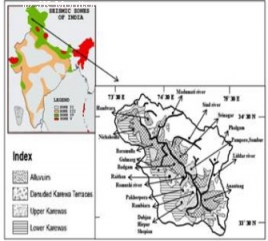 The Karewa soils are composed of fine, silty clays with sand bouldery gravel, the coarse detritus being as a rule, restricted to the peripheral parts of the valley, while the finer variety prevails towards the central parts.
The Karewas soils are classified into four classes of soils.
These classes are known as:
(i) Gruti, (ii) Behil, (iii) Sekil, and (iv) Dazanlad.
Karewas are treasures and have millions years of history buried within them and scientists are yet completely deciphering them. Their study will give us new insights into paleontology and ancient civilization that thrived in Kashmir. But if they are destroyed we will lose this knowledge forever.”
Importance and effects of Karewas Destruction
The Karewas in the Kashmir valley are of great significance. The late Cenozoic deposits exposed in the Kashmir valley assume special significance as they are extensively fluvioglacial, fluvial, lacustrine and Eilean in origin.
1. The Karewas of Kashmir are subject of intense multidisciplinary scientific research. “But the people are completely oblivious of the scientific and historical importance of these landforms.
2. Karewas sediments are witness to and treasure of many human civilizations and habitations. The Stone Age man has survived the harshest of the Pleistocene glaciations. The artifacts left by him are still entrenched in the deep soil horizons of the plateau lands. The choppers, hand axes, and sharp stone blades are worth mentioning, forming a storehouse of the Stone Age factory. So these Karewas have long history of Kashmir buried within them and are very important for us.
3. Apart from the Stone Age man, the remains of Buddhist Stupas on the Karewas show Buddhist influence of the time. The Brahman rulers have also left their footprints on these sediments, which can be seen near Pattan, Awantipora and Mattan. Rishis and Sufi saints are not far behind when it comes to occupying the highest reaches of the Karewas.
4. The climatic and tectonic record during the last 1.6 million years is well preserved in the sediments of the Karewas of Kashmir valley. The Karewas preserve a valuable repository of the late Quaternary climatic changes and the landscape evolution of the Karewa Basin of Kashmir.
5. Aesthetic Value: Karewas are very much beautiful due to the greenery of plants, shrubs and grasses. It attracts people during the flowering blossom period as the white flowering of almonds, apples, pear and peaches are very much attractive and it adds beauty to the whole area. So destroying the Karewas means destroying the Aesthetic value of these plateaus.
6. Ground Water Recharge and Discharge Recharge to the groundwater occurring in Karewas. Spring seepages from within the Karewas and the sub-surface flow of the Jhelum River are sources of discharge of groundwater.
7. The Karewa soils of Kashmir have enormous agricultural potential. Commercial and cash crops like saffron, almond, apples, walnut, peaches, pears, cherry, plum, etc., with orchards and saffron beds. Moreover, some le guminous and fodder crops are also grown in Karewa. The Pampore Karewa is famous all over the world for saffron cultivation.
8. There can be orchards in Karewas which do not need too much wetness as water retention capacity of the Karewas soils are high and they retain moisture for longer periods which are good for crops even in drought conditions.
9. These places also act as natural pastures for cattle, goats and sheep’s, and providing a source of manure for the soils.
10. These Karewas are a home to several plant species, which in turn acts as a habitat for many bird species with in them.
11. Karewas destruction causes instant harm to habitats and kills many species in the process. Habitat Fragmentation results in the loss of resources, such as food and mates.
12. The chirping of birds in the morning were replaced by the roaring of vehicles.
13. These hills were made of fragile of alluvial soil, and unscientific cutting of soil might have disastrous impacts on the environment. These plateaus become prone to soil erosion and reduces the green cover.
14. Reducing green cover means many plant species become vulnerable to extinction, and it leads to the destruction of habitat of many birds.
15. Destroying green cover means more soil erosion and depleting soil fertility. Which become a big problem for poor farmers whose livelihoods are totally depend on such soils.
16. This problem can be solved by making terraces on the Karewas which reduce soil erosion, retaining more water and maintains soil fertility of the Karewas.
17. New residential and commercial establishments are made in or near these Karewas. During heavy rains several households have to leave their homes for safety due to the fear of landslides and land subsidence.
18. Karewas are a source of food and pastures for thousands of livestock’s and in turn a source of livelihood for these people. With the destruction of Karewas the livestock like sheep’s and goats have reduced very fast.
19. Road surfaces converts in a sheet of mud. Which creates health problems for the people.
20. During rains the road becomes slippery due to the mud accumulation on roads, which causes deadly accidents.
21. Whole area is shrouded under a blanket of dust which led to the deterioration of health of humans, plants and animals.
22. Noise Pollution: the continuous soil excavation from these Karewas became a source of noise pollution for the whole area. A local eyewitness and resident said the continuous movement of the vehicle creates discomfort for his whole family and for the entire area.
23. The dust covers the leaves of the plants which causes their death.
24. The continuous vibrations of heavy machines and vehicles makes the soil loose which can trigger heavy landslides causing loss of life and property.
25. During heavy rains the runoff water takes away the soil and chocked the drains and reduces the water carrying capacity of waterbodies and cause shallowness of the rivers and streams. Which in turn become a main cause of flashfloods and floods in Kashmir.
26. Unabated excavation of Karewas and vandalization of forests is fast silting up river Jhelum and other waterways in Kashmir, severely affecting their carrying capacity and hydrological system. In absence of any regulation, excavation of Karewas and felling of trees in forests in catchments of river Jhelum and other waterways is one of the major factors for their extensive siltation. Experts said that this led to overflow of waters in Jhelum and its tributaries during recent devastating floods.
27. The massive excavation of the Karewas locally called Wuder for filling up the floodplains in the Jhelum basin for built-up and other infrastructure development projects like railways and highways has led to enhanced soil erosion from Karewas and siltation of Kashmir’s waterways, particularly Jhelum. This has made it easy for the floodwaters to overflow the Jhelum banks as observed during the recent devastating floods.
28. The Kashmir Valley lies between the Great Himalayan Range to the northeast and Pir-Panjal Range to the southwest. The tectonic-geomorphic setting of the Kashmir Valley reveals that due to rise of the Pir-Panjal Range, the primeval drainage was impounded as a vast lake in which the sediments of Karewa Group were deposited as fill deposits.
29. The Karewas are glacio-fluvial in nature and consists of conglomerate, silt, clay, sands and lignite beds. Experts said after excavation of Karewas and felling of trees in forests, rains carry its run-off in form of silt into the river and waterways. “This has led to extensive siltation of Jhelum and other waterways decreasing their carrying capacity,” he said.
30. The rampant cutting of soil has put thousands of people in future who are going to live near these hillocks at risk. As these disfigured hillocks are prone to heavy landslides.
31. There are thousands of people who earn their livelihoods from the Karewas, by growing crops and other agricultural products, but its destruction causes the lives of such families and farmers at risk.
32. Kashmir is prone to earthquakes and mountains and these small Karewas acts as a balance on earth, which reduces the chances of earthquakes. But the destruction of Karewas will imbalance the land which causes more chances earthquakes in Kashmir resulting in more human and property loss.
33. Source of Volcanic Mountains: there are many volcanic peaks on Karewas. One volcanic peak, 'Soyamji' (1860 metres) is situated in North Machhipura (Handwara) and the other lies in 'Karewa' peak in Tehsil Pahalgam, which is dead so far; the former, however, continued eruption of lava for about l3 months during 1934. These volcanic mountains are the cause of earthquakes in Kashmir. So far twelve devastating earthquakes have occurred in Kashmir. Of these the earthquake of 1885 was the most devastating. Hundreds of houses collapsed, thousands of people died and there were cracks in the earth as a result of this earthquake.
In fact, the agriculture of the valley dominantly survives and sustains on Karewa soils. The world famous saffron from Pampore and apples from Shopian are best examples in support of my claim. The rampant anthropogenic erosion since a couple of years has reduced these plateau lands into ugly ravines. Thus we need to preserve this geological treasure and legacy for the generations to come. Government has to give special attention for preventing the destruction of these special treasures of Kashmir; else the results will be deleterious in the future.
It is mandatory to conserve Jhelum and its catchments including forests and Karewas. Forests, Karewas, rivers and lakes form part of our fragile eco-system. Any disturbance in it can be catastrophic. Government should learn lesson from recent floods that it cannot allow vandalization of natural resources for developmental activities. There is a tremendous scientific and cultural importance of Karewas and its vandalization should be stopped immediately. “Government should initiate necessary legal frameworks to declare Karewas as heritage sites.
- 20 vehicles seized in Shopian for illegal mining
- Farooq reviews beautification of Jhelum bund, strengthening FPC embankments
- Shift to cleaner and more efficient technology to control air pollution: Kumar
- Principal Secy Finance chairs 239th Board of Directors meeting of SFC
- JKHB removes encroachments on Channi park
- PCCF reviews functioning of Wildlife Protection Department in Jammu
- Illegal sand extraction goes unabated in Central Kashmir
- Vehicle loaded with illicit timber seized in Kehmil Forest Division
- LAWDA initiates process of installing biodigesters in houseboats in Dal
- DC Anantnag discusses issues of forest land
- Establish 24x7 snow clearance control rooms from October 17: Div Com to DCs
- Zero tolerance for encroachments; Avoid raising structures along water bodies
- JMC launches beautification drive of Jammu City in collaboration with JK Bank
- PCCF represents State at National Workshop on Climate Change in New Delhi
- Higher reaches receive snowfall in Valley
- MeT predicts rains, snowfall in J&K
- Div Com Kashmir issues Weather Advisory
- PCCF reviews progress of anti-encroachment drive at Jammu
- Kashmir Autumn Festival from Oct 25
- Zero tolerance against timber smuggling, encroachments
- Eco Club of GCW Parade’s ‘Campaign to Stop Polythene’ in college campus
- Sports Council launches Dal cleaning drive
- Anti Encroachment Drive: Govt retrieves 8825 kanals of State, Kahcharai land from encroachers
- Advisor Kumar launches Forest Fire Reporting Mobile application
- Wildlife Week-2018 begins at Dachigam National Park
- School Education Deptt nominates Swachhta Ambassadors
- Cleanliness key to physical well being, emancipated society: Advisor Ganai
- Comm Sec FE&E inaugurates workshop on climate change
- Chief Secretary calls for collective efforts to ensure Swachh JK
- Swachh Bharat Abhiyan, painting competition held at PMTC, KVIC Pampore
- Governor participates in Grand Finale/ Felicitation Ceremony of 'Swachhata Hi Seva' campaign
- Jammu Admin launches massive anti-encroachment drive
- Chugh inspects Forest Research Station Haran
- Kashmir is safe destination for tourists: Tasaduq Jeelani
- Hailstorm destroys crops in Kokernag, officials assess damage
- Residents stage protest, block road against dumping waste at Achan
- Lift material from all dykes along river Jhelum immediately: Div Com to CE I&FC
- JMC organizes Workshop on waste management
- Kashmir Tourism: Countering Negative ‘Positively and Aggressively’ to Attract More Tourists
- Foreign tourist couple trapped in snow rescued in Kargil
- Secretary Forest Department stresses zero tolerance against encroachment
- Kathua Police rescue 29 persons trapped in flood
- SSP Ramban launches afforestation drive
- Encroachment of Forest Land: Govt constitutes probe panel
- Flash floods: JK Police, SDRF conduct rescue operations, clear blocked road
- Moderate to heavy rains, snowfall likely in JK during next 48-hours
- Beautiful hills (Karewas) turned into valleys of death and destruction
- Establish Winter Joint Control Rooms: Div Com to DCs
- 13th Standing Committee meet of State Board for Wildlife
- LAWDA demolishes illegal structures in Kashmir capital Srinagar
- Govt notifies revised SOPs for State Disaster Relief Fund
- Pvt Company plundering agro-forest land: Yatoo
- JK State Disaster Mitigation Fund: Rs 10 cr earmarked for mitigation process
- DDC Kupwara for immediate removal of toilets from embankments of water bodies
- DC launches 'Swachtta hi Sewa' Campaign at Kishtwar
- Mobilise people, reinforce mass movement for sanitation: DC to officers
- ‘Swachhata Hi Seva': Governor declares J&K ODF
- 2438.20 kanals of State land, 5763.60 kanals of Kahcharai land retrieved
- Dal, Jhelum restoration pivotal to Srinagar Smart City Project: CS
- Students, teachers need to spread message of cleanliness: Advisor Ganai
- DDC Kupwara flags off ‘Swachhata Hi Seva’ rally
- Govt constitutes Committee for revision of timber sale rates
- DC Budgam launches ‘Swachhta Hi Seva’ fortnight
- DDC Kupwara reviews progress of anti-encroachment drive
- Arrangements for nationwide sanitation campaign ‘Swachhta Hi Seva’ finalized in Budgam
- Hail storm hits parts of Budgam and Baramulla district
- Efforts underway to bring Bollywood back, remove negative perception: Dir Tourism
- Hakeem aghast over slow pace of works at Doodhpathri-Tossamaidan
- Udhampur declared ODF with successful culmination of Maha-Shramdaan
- DIPR conducts plantation drive at Media Complex Jammu
- 12 illegal structures demolished at Zahidpora Hawal
- DC Jammu reviews arrangements for ‘Swachhta Hi Seva’ campaign
- Apple season: A Backbone of Kashmir’s Economy